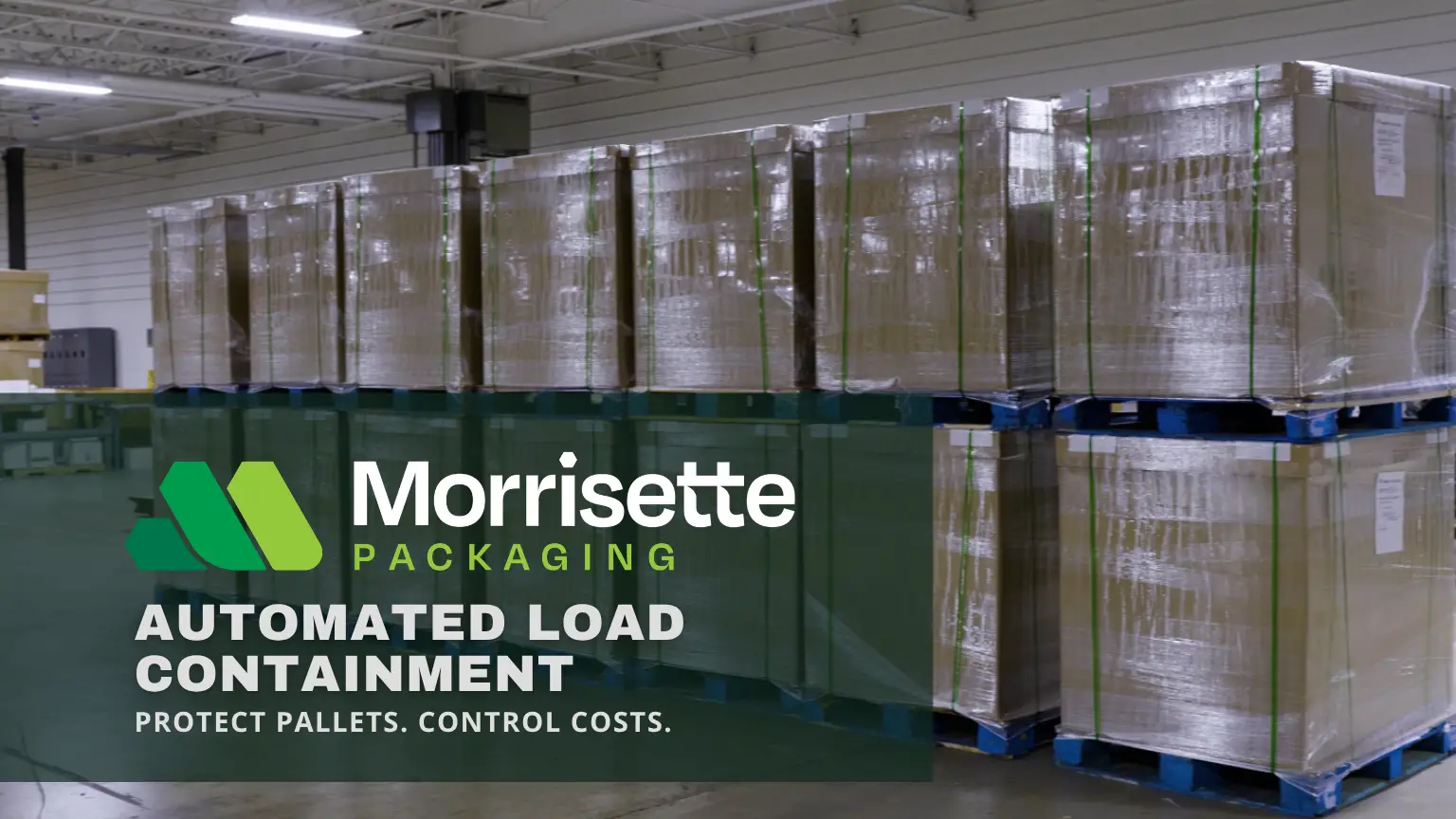
Load Containment: How Automated Stretch Wrapping Protects Pallets and Controls Costs
A pallet can look secure and still be at risk.
Once a load leaves your facility, it may encounter forklift handling, loading docks, trailer vibration, sudden stops, turns, uneven pavement, cross-docks, and long stretches of transit. If the load is not properly contained, products can shift, lean, crush, or fall—turning a packaging issue into damaged goods, rejected deliveries, rework, and unnecessary cost.
That is why load containment matters.
The goal of stretch wrapping is not simply to apply film around a pallet. The goal is to create the right amount of consistent containment force so the load stays stable from your dock to your customer’s.
What Is Load Containment?
Load containment is the ability of a palletized load to remain stable, intact, and safe to ship throughout handling, storage, and transportation.
Containment force is the inward pressure that stretch film applies around a palletized load. It is created by the amount of wrap force applied to each layer of film, multiplied by the number of film layers at a specific point on the load.
In simple terms, containment force is what holds the load together.
The right amount of force depends on the load itself. A light, crushable load should not be wrapped the same way as a dense, heavy pallet. An unstable mixed-SKU pallet may need a different wrap pattern than a uniform pallet of corrugated cases.
There is no one wrap setting that works for every product.
Why Pallet Loads Fail in Transit
A poor stretch-wrap result is not always obvious when the pallet is sitting still on your warehouse floor.
Loads can fail because of:
-
Inconsistent wrap force
-
Too few film layers in critical areas
-
Insufficient film overlap
-
Weak anchoring at the pallet base
-
Film breaks during wrapping
-
Improper pre-stretch settings
-
Product overhang or sharp corners
-
Unstable pallet patterns
-
Loads that are too tightly wrapped and become crushed or distorted
-
Inconsistent wrapping between employees, shifts, or locations
A pallet may look tightly wrapped, but visual appearance alone does not confirm whether it has the right containment force to withstand transit.
The Challenge With Manual Stretch Wrapping
Hand wrapping can be a practical option for low-volume operations, unusual loads, or occasional shipments. However, as volume grows, manual wrapping can become harder to control.
Different operators may apply film with different tension, different overlap, different numbers of revolutions, and different wrap patterns. Fatigue can also affect consistency over the course of a shift.
That inconsistency can create two common problems:
Not Enough Containment
When a load does not have enough containment force, products may shift, lean, or separate during shipment. This increases the likelihood of damage, rework, rejected loads, and customer dissatisfaction.
Too Much Film
When teams are unsure whether a load is secure, the instinct is often to add more film.
More film does not always mean a better load. Excess film can increase material costs, slow down the wrapping process, and still fail to create the right containment force in the locations where the load needs it most.
The goal is not to use the most film possible. The goal is to use the right amount of film to achieve the right level of containment.
How Automated Stretch Wrapping Improves Consistency
A properly configured stretch wrapper can help create a more repeatable process by applying a defined wrap pattern and more consistent wrap force from load to load.
Depending on your application, a semi-automatic or automatic stretch wrapper can help improve:
-
Consistency in film application
-
Control over wrap force and film layers
-
Throughput in high-volume shipping areas
-
Operator ergonomics
-
Film use and material visibility
-
Load stability during transit
-
Repeatability across shifts
-
Ability to standardize wrapping across facilities or product lines
Automation does not eliminate the need for a smart wrapping strategy. It gives your team a more controlled way to execute one.
To see what repeatable containment force looks like in practice, read the BD LeanWrap case study—a real-world example of how automated wrapping improved load consistency and reduced damage.
Load Containment Is More Than a Machine Setting
Achieving the right containment force requires a complete look at the load and the process around it.
That includes:
-
Product weight and stability
-
Pallet size and condition
-
Product overhang
-
Pre-stretch capability
-
Number of film layers
-
Wrap force settings
-
Bottom and top wrap counts
-
Film delivery speed
-
Trailer, carrier, and shipping conditions
A machine setting that works well for one load may not work for another. That is why measuring, testing, and adjusting are so important.
How to Measure Containment Force
Containment force should be measured at multiple locations on the pallet—not just in one spot.
The top, middle, and bottom of the load can each behave differently. Measuring at several points helps identify whether the load has consistent force throughout the areas most likely to shift during transit.
Morrisette Packaging Specialists can evaluate your current stretch-wrap process, measure containment force, assess the condition of your loads, and help identify opportunities to improve stability, film use, and efficiency. Schedule a conversation to get started.
Choosing the Right Stretch Wrapping Solution
The right stretch wrapper depends on your operation.
A semi-automatic machine may be the right fit for a facility with moderate volume and a dedicated wrapping station. An automatic system may make more sense for high-throughput operations, conveyor integration, or facilities looking to reduce forklift travel and manual handling.
Morrisette can help evaluate:
-
Loads wrapped per day and peak shipping periods
-
Pallet sizes, weights, and product mix
-
Current film use and cost
-
Damage and rework history
-
Available floor space
-
Operator workflow
-
Conveyor and forklift integration needs
-
Desired levels of automation
-
Return-on-investment opportunities
The best solution is not always the biggest machine. It is the solution that gives your operation reliable containment force, practical workflow improvements, and measurable value.
Protect the Load. Control the Cost.
Every pallet that leaves your facility represents your product, your brand, and your customer experience.
Proper load containment helps reduce the risk of damaged goods while creating a more controlled and repeatable stretch-wrapping process. With the right film, equipment, settings, and testing strategy, you can protect your product without wrapping more than necessary.
At Morrisette, we help companies improve load stability from every angle—from stretch film and containment-force testing to semi-automatic and automatic stretch wrappers, line integration, and ongoing support.
Ready to find out whether your pallets have the containment force they need? Schedule a free coffee and consultation with a Morrisette Packaging Specialist.