Packaging Automation: How to Increase Throughput Without Adding Bottlenecks
When production goals rise but labor, space, and time stay tight, it is easy for a packaging line to become the bottleneck.
Maybe operators are spending too much time erecting boxes, or finished products are waiting to be packed, sealed, labeled, or palletized.
Maybe the line runs well at the beginning of a shift but slows down as repetitive tasks create fatigue.
It could also be that your output is inconsistent because a process depends too heavily on manual steps.
Packaging automation can help solve all of these problems.
The goal is not simply to replace people with equipment. The goal is to put people in positions where they can do higher-value work while automation handles repetitive, physically demanding, and highly repeatable tasks.
What Is Packaging Automation?
Packaging automation uses equipment to complete or assist with steps in the packaging process that would otherwise be done manually.
Depending on your operation, that may include:
-
Case erecting and bottom sealing
-
Case packing
-
Case sealing
-
Conveyor systems
-
Labeling and coding
-
Shrink wrapping
-
Stretch wrapping
-
Strapping
-
Palletizing
-
Material handling and product movement
The right solution depends on your product, available space, production volume, packaging materials, labor needs, and future growth plans. There is no one-size-fits-all automation system, and there should not be.
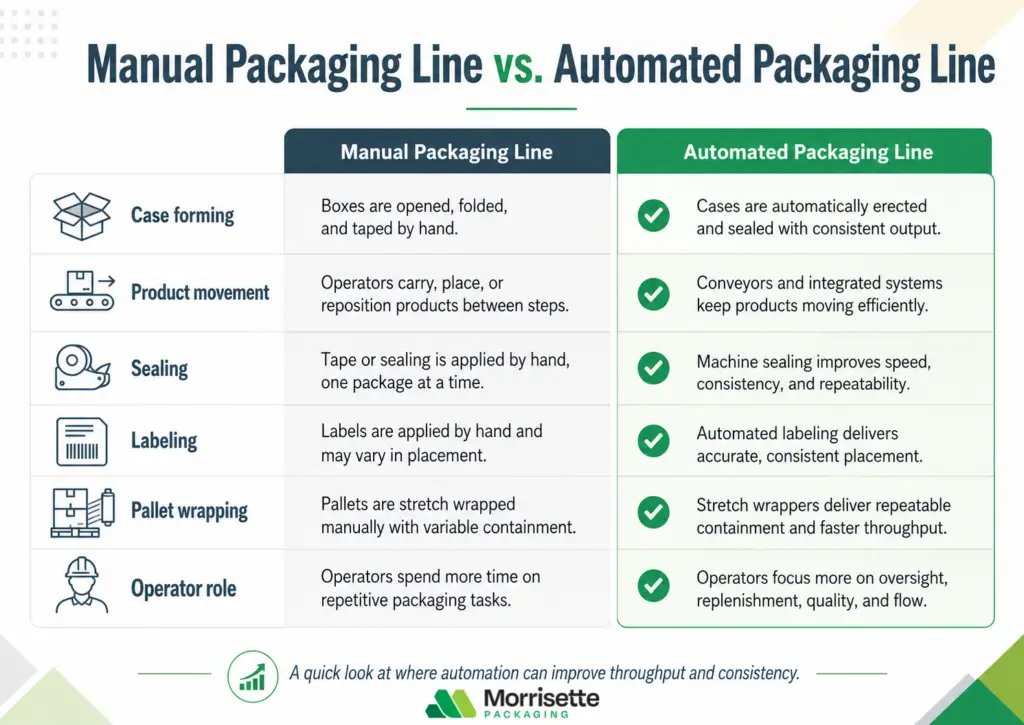
5 Signs Your Packaging Line May Be Ready for Automation
1. Repetitive packaging tasks are slowing down production
Repetitive manual tasks can take more time than most operations realize. Folding boxes, applying tape, loading products, labeling cartons, and wrapping pallets may each seem simple on their own. Across hundreds or thousands of units, though, those steps can quickly become the constraint that limits your entire line.
Automation can help create a more predictable pace and keep products moving between stations.
2. Your team is experiencing fatigue or repetitive-motion strain
Manual packaging requires operators to repeat the same motions over and over: bending, lifting, taping, reaching, stacking, and wrapping.
That work is important, but it can also be physically demanding. As fatigue builds, speed and consistency may decline. Automating the most repetitive portions of the process can help reduce unnecessary physical strain while allowing operators to focus on setup, quality checks, material replenishment, troubleshooting, and other value-added responsibilities.
3. Output varies from shift to shift
A line that relies entirely on manual processes may produce different results due to staffing, training, fatigue, product mix, or the pace of the day.
Automation helps standardize repeatable tasks. That can mean more consistent carton forming, sealing, labeling, wrapping, and pallet preparation while also making it easier to build a process that is easier to train and maintain.
4. Your packaging area is creating a bottleneck
A fast production process can still be held back by a slow packaging operation.
When products are waiting to be loaded into boxes, sealed, labeled, or prepared for shipment, the issue may not be production capacity. It may be packaging capacity. A targeted automation upgrade can remove a single bottleneck without requiring a complete redesign of your facility.
5. You are planning for growth
Automation is often most valuable when it is planned before a line reaches its breaking point.
Whether you are entering a new market, adding SKUs, increasing order volume, bringing fulfillment work in-house, or preparing for a larger facility, automation can help create a process that is easier to scale. The key is selecting equipment that supports where your operation is headed, not only where it is today.
A Common Starting Point: Case Erecting and Sealing
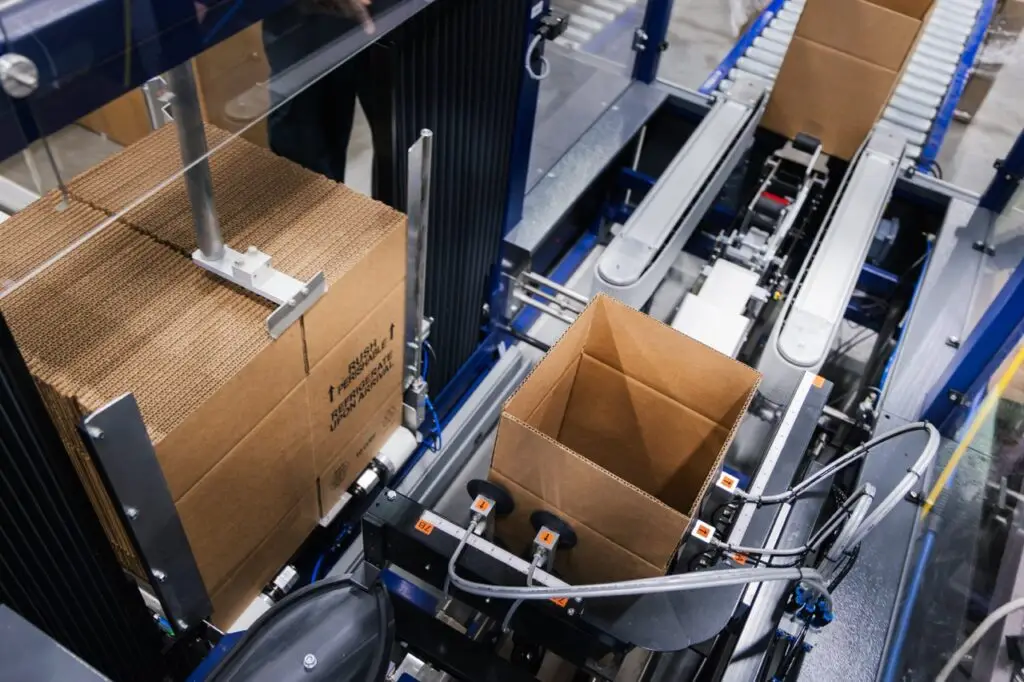
One of the most common opportunities for packaging automation is case erecting and sealing.
In a manual process, an operator may need to pull a flat corrugated box from a stack, open it, fold the bottom flaps, hold the carton in place, and apply tape. That process is repeated one box at a time throughout the day.
A case erector can automatically pull flat cases from a magazine, form the box, fold the bottom flaps, seal the bottom, and send the erected case down the line.
Instead of spending the entire shift repeatedly building boxes by hand, an operator can focus on replenishing the case magazine, monitoring the process, handling quality checks, or supporting the next stage of production.
The result is a more consistent flow of ready-to-pack cases and fewer interruptions at the beginning of the packaging line.
Automation Is Not Just About Speed
Speed matters, but it is not the only reason to automate.
The right equipment can also help improve:
-
Consistency in how packages are formed, sealed, labeled, and wrapped
-
Product flow between workstations
-
Ergonomics for operators performing repetitive tasks
-
Material use and packaging quality
-
Visibility into line performance
-
Capacity planning for future growth
-
Reliability across shifts and product runs
Automation should support the full packaging process, not create a faster version of a problem somewhere else on the line.

Start With the Bottleneck
The best automation projects usually begin with a simple question:
Where is work backing up?
Look for the place where operators are waiting, products are stacking up, or production slows down. That may be box forming, product loading, carton sealing, labeling, pallet wrapping, or moving materials from one station to another.
Once you identify the bottleneck, you can evaluate the best path forward. In some cases, that may be a tabletop machine or a semi-automatic solution. In others, a fully integrated line may make sense.
The right answer is not always the largest or most complex system. It is the solution that improves the flow of your operation and delivers measurable value.
What to Consider Before Investing in Packaging Automation
Before choosing equipment, take a close look at:
-
Current and projected production volume
-
Product dimensions, weights, and variability
-
Case sizes and packaging materials
-
Available floor space and line layout
-
Required changeover frequency
-
Labor challenges and ergonomic concerns
-
Upstream and downstream process capacity
-
Maintenance, service, training, and support needs
A packaging automation project works best when equipment, materials, workflow, and people are considered together.
Build a Smarter Packaging Line With Morrisette
At Morrisette Packaging, we help companies evaluate packaging processes from every angle—from corrugated cases, protective materials, and custom packaging design to equipment, layout, installation, training, and long-term support.
Whether you need a single-case erector, a stretch wrapper, a labeling system, a conveyor solution, or a more complete automated packaging line, our team can help you identify where automation can make the biggest difference.
A better packaging process does not always start with a complete overhaul.
Sometimes, it starts with one bottleneck.
Ready to explore what is possible? Schedule a free coffee and consultation with one of our Packaging Specialists.
Frequently Asked Questions About Packaging Automation
What types of packaging tasks can be automated?
Many repetitive steps in a packaging line can be automated, including case erecting and sealing, product loading, labeling and coding, shrink wrapping, stretch wrapping, and robotic palletizing. The right mix depends on your production volume, product dimensions, and facility layout. A packaging automation specialist can help you identify which tasks offer the greatest return on investment.
How do I know if my packaging line is ready for automation?
Common signs include repetitive manual tasks slowing down output, operator fatigue from physically demanding work, inconsistent throughput between shifts, a packaging area creating a bottleneck, or plans to scale production. You do not need to automate everything at once—many operations start with a single bottleneck and build from there.
Does automation require a complete line overhaul?
Not at all. Many companies begin with a targeted upgrade—such as adding a case erector, an automatic taper, or a stretch wrapper—to solve one specific problem. A phased approach allows you to see measurable results quickly and plan future investments based on real performance data rather than projections.
What should I consider before investing in packaging automation equipment?
Key factors include your current and projected production volume, product dimensions and variability, case sizes and packaging materials, available floor space, changeover frequency, labor challenges, and long-term growth plans. The best automation solution is one designed around your specific operation—not a generic system applied to every situation.
Where does Morrisette serve customers?
Morrisette serves businesses across the Carolinas and Virginia, with locations and service areas throughout the region. Our team works with customers in:
- Charlotte, NC
- Greensboro, NC
- Raleigh, NC
- Hickory, NC
- Columbia, SC
- Greenville, SC
- Roanoke, VA
- Danville, VA
No matter where you are in the region, our packaging automation solutions team can help you evaluate your line, recommend the right equipment, and support you through installation and beyond. Reach out to your nearest location to get started.
Contributed by Greyson Taylor
About Greyson: I am a mechanical engineer by schooling and have been in the packaging world for about 10 years now. My experience with equipment has included several “hats”. These functions have included equipment validation, writing specifications for how equipment should function, layout design, and contractor management for equipment installation/startup. My title at Morrisette is packaging equipment engineer and I align myself well with Morrisettes core values. Morrisette strives to make their customers more profitable. I help in this goal by making customers more efficient by means of reducing labor costs and increasing production.