
Sustainability is the buzzword of a generation – and rightfully so.
At Morrisette Packaging, we welcome every initiative that helps us become better stewards of the environment.
Our biggest strength is our material-neutrality. Having no proprietary packaging material to sell you allows us to remain objective as we work to find the best solution for your specific sustainable packaging goals.
Sustainable Packaging is seeing exponential growth as an industry – approaching a market value of nearly HALF A TRILLION DOLLARS within the next ten years.
This means there is no shortage of companies hoping to sell you their new proprietary blend of something they claim to be “sustainable packaging.”
It seems fair to wonder if a company is offering you the best solution when that same company manufactures what they call the best solution.
What is Sustainable Packaging?
Sustainable packaging refers to any environmentally friendly materials used for wrapping, storing, shipping, or shelving products.
Whether you are looking for sustainable packaging materials, sustainable food packaging, or other sustainable packaging solutions, we can help.
This seems like a good time to point out a common misconception in the sustainable packaging conversation:
The common perception is that paper products are a more sustainable packaging material than plastics by default.
But that’s not always true.
According to National Geographic:
[P]aper is very resource-heavy to produce: Manufacturing a paper bag takes about four times as much energy as it takes to produce a plastic bag, plus the chemicals and fertilizers used in producing paper bags create additional harm to the environment.
Many, many, many other studies show that in certain cases, “plastic packaging containers were found to have a lower environmental impact than the glass and paperboard solutions.”
Three Key Examples:
Our results show that paper bags, even with 100% recycle content, have significantly higher average impacts on the environment than either of the reusable bags or singe-use plastic retail bags.
R.M. Kimmel, Life Cycle Assesment of Grocery Bags in Common Use in the United States, Environmental Studies, Clemson University Digital Press 2014
This study supports the conclusion that the standard polyethylene grocery bag has significantly lower environmental impacts than a 30% recycled content paper bag and a compostable plastic bag.”
Resource and Environmental Profile Analysis of Polyethylene and Unbleached Paper Grocery Sacks, Franklin Associates Ltd for the Council for Solid Waste Solutions
The paper bag has to be used four times or more to reduce its global warming potential to below that of the conventional HDPE bag, but was significantly worse than the conventional HDPE bag for human toxicity and terrestrial ecotoxicity due to the effect of paper production. The cotton bag has a greater impact than the conventional HDPE bag in seven of the nine impact categories even when used 173 times…The impact was considerably larger in categories such as acidification and aquatic and terrestrial ecotoxicity due to the energy used to produce cotton yarn…
C. Edwards & J.M. Fry, Life Cycle Assesment of Supermarket Carrier Bags Avaiable in 2006, Report SC030148, Environemtn Agency, 2011
You have to consider the entire life cycle of a material to make the most informed decision about its environmental impact.
Morrisette Packaging provides sustainable packaging solutions, championing a material-neutral philosophy that underscores the significance of the packaging process over the material itself. This innovative approach recognizes that true sustainability transcends the confines of material selection, focusing instead on the holistic impact of packaging on our environment.
What is the Life Cycle Assessment (LSA) in Sustainable Packaging?
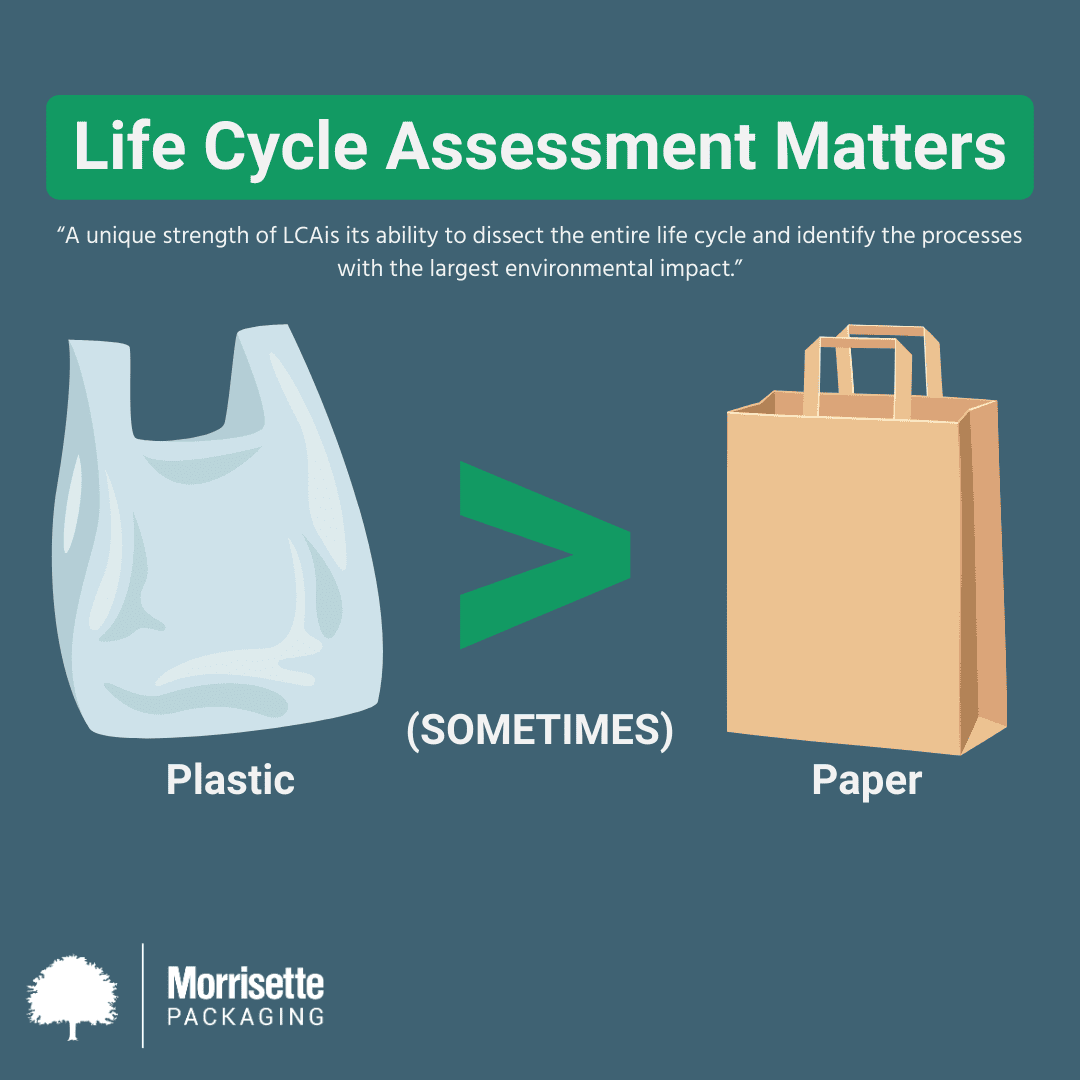
The Life Cycle Assessment of a packaging material must be examined if an informed decision is to be made about your sustainable packaging.
Life cycle assessment (LCA) is a scientific methodology standardised in the ISO 14040 and ISO 14044 technical standards, developed for assessing and quantifying the potential environmental impacts associated with entire product and services life cycles.
Rigamonti, L., Mancini, E. Life cycle assessment and circularity indicators. Int J Life Cycle Assess 26, 1937–1942 (2021)
There is no universal answer when it comes to sustainable packaging.
So, how do you know what’s best for you and your sustainable packaging goals?
Trust Through Transparency
At Morrisette Packaging, we are material-neutral. We work to earn your trust by being as transparent as possible throughout the process of finding your best solution.
By entering the sustainable packaging conversation without a preferred solution, we avoid any temptation to hold back data points or evaluations simply because they don’t support our preferred solution.
Our preferred solution is to find your best solution. That’s where our objective begins and ends.
We evaluate your needs and then deliver a solution tailored for you, not for us.
And when possible, we will help you understand how your current operation can become more sustainable with just a slight shift in your current process.