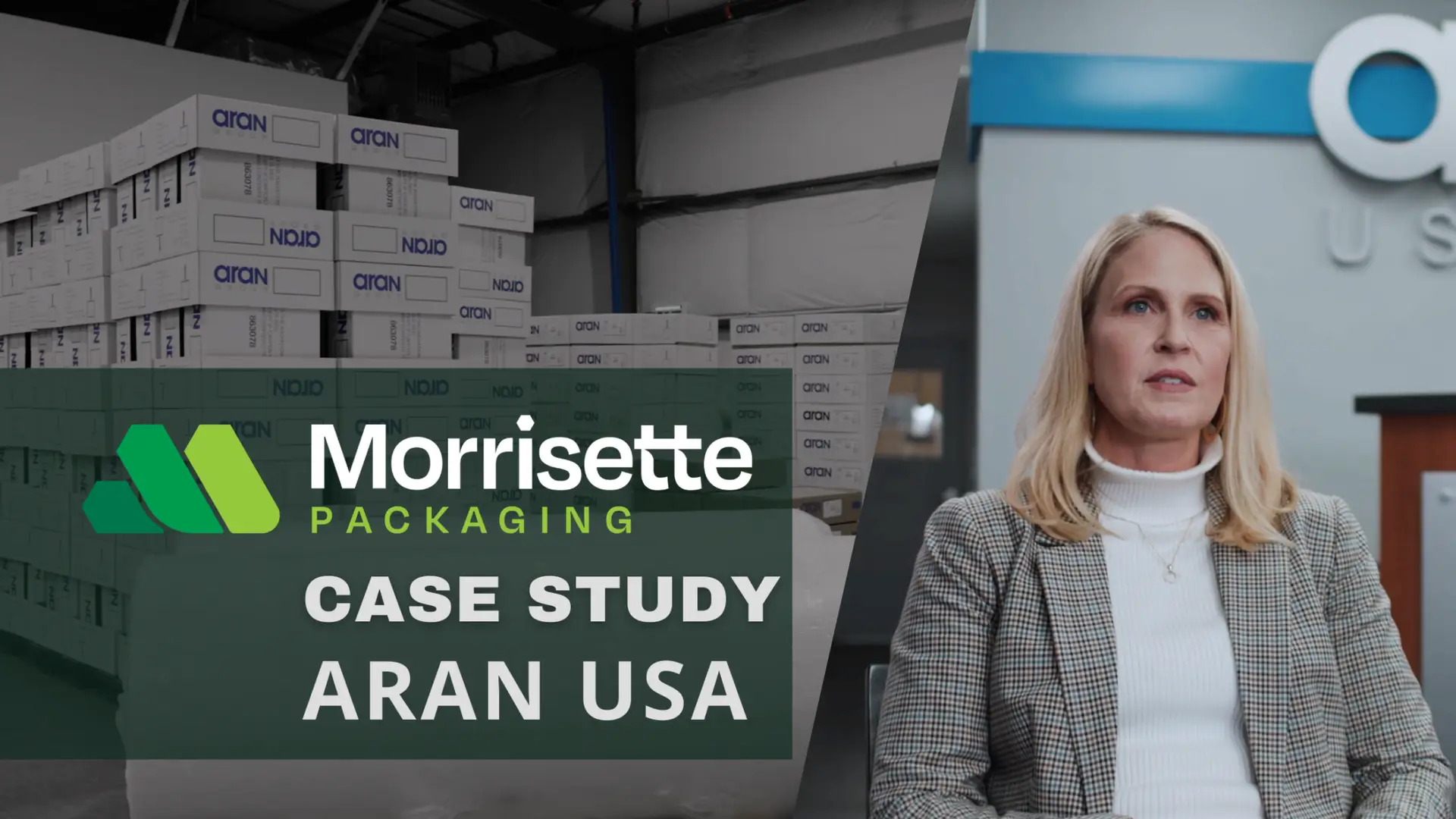
Kevin LeCompte will tell you the money wasn’t what started the conversation.
Aran USA had been working with Morrisette Packaging for years before anyone talked about redesigning a box.
Kevin, Aran’s General Manager, describes the relationship as reliable and responsive.
Morrisette Packaging supplied Aran with consumables across the board: cardboard boxes, corner boards, and the everyday materials that keep a manufacturing facility running.
That trust is why, when Aran’s purchasing manager Victoria and Morrisette Packaging Specialist Elizabeth Lostetter started talking about a better box, the conversation actually went somewhere.
Why the Box Mattered So Much
Aran USA is in the bag and box business. They take film on reels and convert it into flexible bags.
The most familiar example Kevin gives is the plastic bladder inside a box of wine. Those bag-in-box formats go into packaging, get palletized, sterilized, and shipped to customers across the country. One box size accounts for roughly 85% of their total production volume.
When a single box size drives that much of your output, the performance of that box is not a secondary concern. It is the production line.
And for Aran USA, the production line had a problem.
The old box design was short in height, which sounds like a minor spec detail until you think through what it means structurally. A short box means unusually large top and bottom flaps. Large flaps mean most of the corrugated material (and most of the cost) is concentrated in areas that provide no structural integrity. The sides and corners, where strength actually lives in a corrugated box, were carrying less material than they should. The flaps were carrying more than they needed to.
The result on the production floor was exactly what you’d expect. Boxes would catch in the machine, tear, and cause stoppages. Workers were constantly fighting the equipment instead of running it.
The boxes worked, technically. They just didn’t work well.
The Custom Packaging Idea
The solution didn’t come from a sales presentation.
It didn’t come from a rep walking in with a catalog.
It came from Victoria and Elizabeth sitting together with a problem in front of them and working through it. Victoria knew the pain points on the floor. Elizabeth knew what was possible from a design and sourcing standpoint.
The telescoping box concept came out of that conversation.
We like to call this “Innovation through collaboration.”
A telescoping box is a two-piece design: a base tray and a lid tray that slides over it. Simple in concept, but the structural implications are significant.
When the lid closes over the base, all four sides and all four corners become double-wall. That’s where a corrugated box needs its strength.
The top and bottom of each tray, meanwhile, become single-wall because the telescoping double-up already provides the vertical strength needed to stack. The result is a box that uses material where it counts and eliminates it where it doesn’t.
Critically, the new design maintains the same edge-crush test (ECT) performance as the old box. Structural integrity didn’t get traded away for cost savings. It got redistributed to where it actually does something.
We would love to learn more about you, your goals and what we can do to help make every day better. Click here to schedule a time for a free coffee and consultation at your location with one of our Packaging Specialists.
Validation Before Commitment
Switching the primary box for 85% of your production volume is not a decision you make lightly. Kevin and the Aran team knew that, and so did Morrisette Packaging.
Before anything went into production, the new telescoping box underwent drop tests and shaker-table testing designed to simulate the stresses of shipping to the West Coast. Everything passed.
From there, the team traveled to Lantech’s facility for a Factory Acceptance Test before the equipment shipped. That went smoothly too. When the machine arrived and was installed on-site, it came in without incident.
Morrisette technician John Traxler handled the on-site implementation.
The line now batch-runs lids, then quickly changes over to run the base trays, with a queue built up to sustain production through two off-shifts.
Kevin describes finding the “sweet spot” on queue size as one of the more satisfying parts of getting the system dialed in. The process of getting there was methodical rather than rushed, which is a meaningful detail.
A faster rollout would have been riskier. This one was built to last.
The automation solutions Morrisette brought to the project weren’t an afterthought. The Lantech equipment is what makes the two-piece telescoping format practical at the production scale.
A custom box design that can’t run efficiently on the line isn’t a solution. It’s a different problem.
Getting the design and the automation right together is what turned this from a concept into a competitive advantage.
The Numbers
About four to five months in, running through their busiest season — West Coast tomato season — Kevin reports zero complaints from customers.
That’s the qualitative outcome. The quantitative ones are just as telling.
The new box uses roughly 30% less material than the old design. That’s not an estimate or a projection. It’s the result of eliminating material that never added structural value in the first place and redistributing it to the walls and corners that did.
Pallet density improved from 160 units per pallet with the old box format to 300 trays per pallet with the new telescoping design.
Nearly double.
That’s not a trivial number for a manufacturer shipping product to the West Coast. Freight costs, warehouse cube, staging space – all of it gets better when you fit nearly twice as many units on a pallet.
On the production floor, the machine stoppages that workers used to fight are gone. Line efficiency is up. And downstream, customers who open the boxes to access the bags inside no longer have to wrestle with bulky flaps.
Structural performance improved. Costs went down. The floor runs cleaner. Customers are happier. That’s a clean sweep.
What This Actually Took
Kevin is direct about something that often gets glossed over in case studies: the financial savings alone wouldn’t have started this conversation if the relationship with Morrisette wasn’t already solid.
A redesign of this scope requires trust.
You’re changing the primary packaging format for the majority of your production volume, investing in new automation equipment, putting your line through a validation process, and asking your team to learn a new workflow.
None of that happens because someone showed you a good ROI spreadsheet. It happens because you trust the people proposing the change and you believe they’ll stand behind the outcome.
That’s the context Kevin provides. Years of reliable service, good relationships with every rep, and a track record of making things right when something went sideways.
The packaging solutions Morrisette brought to Aran weren’t sold. They were earned.
Elizabeth brought the packaging design thinking. John Traxler brought the technical execution. Victoria brought the operational knowledge and the willingness to push for something better.
The result is a system that runs cleaner, costs less, and ships better than what they had before.
That’s what it takes. And it’s repeatable.
FAQ
What is a telescoping box design? A telescoping box uses two trays: a base and a lid that slides over it. When closed, all four sides and corners have double-wall thickness, providing structural strength where it matters most while reducing material in the top and bottom flaps.
How much corrugated material can a telescoping box save compared to a standard design? In Aran USA’s case, switching to a telescoping box reduced material usage by approximately 30% compared to their previous box, which concentrated excess material in the flaps rather than the walls and corners.
Can a telescoping box design maintain the same structural performance as a standard corrugated box? Yes. A properly engineered telescoping box can match the edge-crush test (ECT) rating of a conventional design while redistributing material to the areas that provide the most structural benefit.
What automation equipment is typically used with telescoping box designs? Lantech case erectors and related automation equipment are well-suited to running two-piece telescoping formats at production scale. The ability to run lids and bases in batches with fast changeover is a key factor in making the format efficient on a high-volume line.
How do I know if my current box design is costing more than it should? If your boxes have large flaps relative to the wall height, if your line experiences frequent jams or tears, or if your pallet density feels lower than it should be, those are signals worth exploring. A packaging assessment can identify where material and efficiency gains are available.