

Stretch Film Guide: How to Choose the Right Stretch Wrap for Your Pallets
Stretch film is one of the most common materials in shipping and warehouse operations—and one of the easiest to underestimate.
A pallet can look wrapped and still be poorly protected. Too little film, too much film, the wrong film type, poor overlap, inadequate wrap force, or an unstable pallet pattern can all create problems once a shipment leaves your facility.
The goal is not simply to cover a pallet in plastic.
The goal is to create a stable, safe-to-ship load while using the right amount of film for the job.
This guide explains what stretch film is, how the main film types differ, when hand wrapping or machine wrapping makes sense, and how to choose a better stretch-wrap solution for your operation.
What Is Stretch Film?
Stretch film—also called stretch wrap or pallet wrap—is a highly stretchable plastic film used to secure products together on a pallet.
As the film is applied around the load, it stretches and creates inward pressure that helps hold the products in place. This helps reduce shifting during storage, forklift handling, loading, transit, and delivery.
Stretch film is commonly used to:
-
Secure corrugated cases on pallets
-
Stabilize mixed-SKU loads
-
Help protect products from dust and light handling exposure
-
Keep unitized loads together during transportation
-
Improve consistency in warehouse and shipping operations
-
Support safer handling of palletized products
Stretch film is not the same as shrink film. Shrink film is applied loosely and shrinks with heat. Stretch film is applied under tension and relies on its elastic recovery to help hold the load together.
Morrisette carries a full range of stretch film and packaging products for hand and machine applications.
What Does Stretch Film Actually Do?
A good stretch-wrap application should help create a load that remains stable throughout the shipping journey.
That includes helping the pallet withstand:
-
Forklift movement
-
Trailer vibration
-
Turns and sudden stops
-
Dock handling
-
Cross-dock transfers
-
Uneven roads
-
Stacking and storage conditions
-
Routine carrier handling
The core performance goal is load containment.
Containment force is the inward force created when stretch film is applied around a pallet. The correct containment force depends on the product, pallet pattern, load weight, product fragility, shipping conditions, and the way the pallet will be handled.
A light, crushable pallet should not be wrapped the same way as a dense load of industrial products. A mixed pallet with irregular shapes may need a different film, wrap pattern, or number of film layers than a uniform load of corrugated cases.
For a deeper look at containment force, load testing, and how to establish the right wrap spec for your pallets, see our guide: Stretch Wrap Containment Force Explained.
Hand Stretch Film vs. Machine Stretch Film
The first decision many operations face is whether to wrap pallets by hand or use a stretch-wrapping machine.
Hand Stretch Film
Hand stretch film is designed to be applied manually, usually with a handheld dispenser or extended core.
It can be a practical solution for:
-
Lower-volume shipping operations
-
Occasional pallet wrapping
-
Unusual or oversized loads
-
Facilities without a dedicated wrapping station
-
Applications where a machine does not fit the workflow
However, hand wrapping can produce variation between employees, shifts, and loads. Film tension, overlap, wrap count, and wrap pattern can all change depending on the person performing the task.
That does not automatically make hand wrapping ineffective. It does mean that training, process standards, and film selection matter even more.
Machine Stretch Film
Machine stretch film is designed for use with semi-automatic or automatic stretch wrappers.
A properly configured machine can help deliver a more consistent wrap pattern, controlled pre-stretch, predictable wrap force, and repeatable film application. It can also reduce the physical demand of manually walking around a pallet while applying film.
Machine wrapping may be a good fit when your operation has:
-
Consistent pallet volume
-
Repetitive pallet sizes or load types
-
A need for more consistent containment force
-
High film consumption
-
Shipping-area bottlenecks
-
Ergonomic concerns around manual wrapping
-
A need to integrate wrapping into a conveyor or forklift workflow
The right choice depends on your volume, load mix, floor space, labor needs, shipping process, and growth plans.
Explore Morrisette’s automation solutions to see the range of stretch wrapping equipment available.
Cast Stretch Film vs. Blown Stretch Film
Stretch film is often categorized by how it is manufactured: cast film or blown film.
Both can be useful. The better choice depends on your load, equipment, environment, and performance requirements.
Cast Stretch Film
Cast film is produced through a process that rapidly cools the film after extrusion.
It is often valued for:
-
High clarity for easier load visibility
-
Quiet and smooth unwinding
-
Consistent thickness
-
Good cling characteristics
-
Efficient performance in many standard applications
Cast film is commonly used in both hand-wrap and machine-wrap applications.
Blown Stretch Film
Blown film is produced through a different process that uses slower air cooling.
It is often selected for applications that need strong holding performance, puncture resistance, or performance on more challenging loads. It may have a different feel, unwind characteristic, and noise profile than cast film.
The important point is this: cast and blown are not automatic shortcuts to a film recommendation.
Film technology has advanced significantly. High-performance, multi-layer, hybrid, pre-stretched, thinner-gauge, recycled-content, and specialty films can all offer different performance advantages. The right solution should be chosen based on the actual load—not a general rule of thumb.
How to Choose the Right Stretch Film
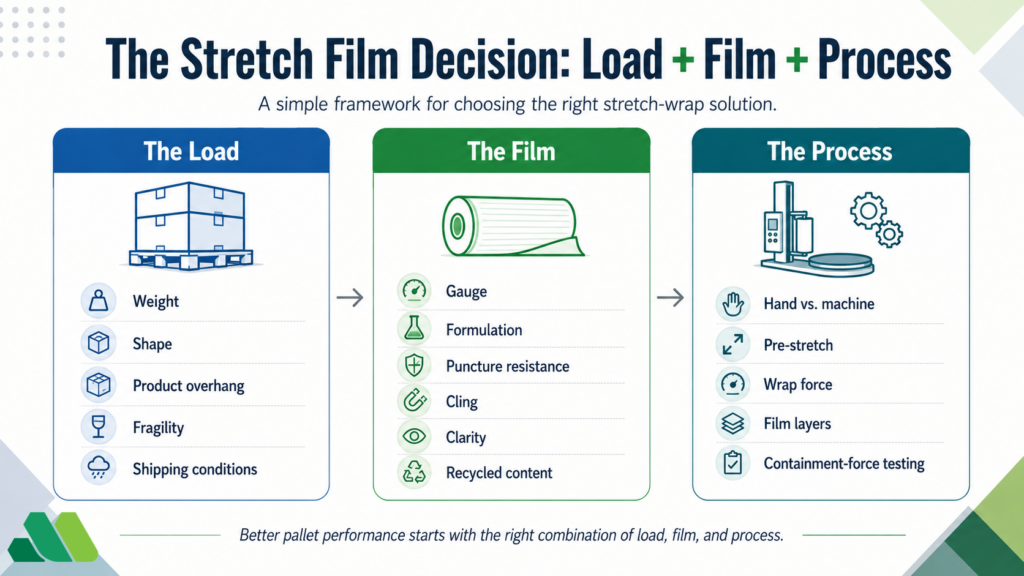
Before choosing a film, start with the pallet.
Ask these questions:
-
How much does the load weigh?
-
Is the load uniform, irregular, or mixed?
-
Does product overhang the pallet?
-
Is the product crushable or sensitive to compression?
-
Are there sharp corners or protrusions that could puncture the film?
-
Does the pallet need to be stored outdoors?
-
Will the load move through cold, heat, humidity, or demanding shipping conditions?
-
How many pallets are wrapped each day?
-
Is the current process done by hand, forklift, or conveyor-fed equipment?
-
What containment force does the load need to remain stable in transit?
The answers help determine the right film gauge, film formulation, stretch capability, wrap pattern, equipment settings, and number of layers.
If your loads have product overhang, unstable pallet patterns, or complex configurations, our Packaging Design team can help evaluate the full picture.
Why More Film Is Not Always Better
When a pallet does not feel secure, many teams respond by adding more film.
That may solve the immediate concern, but it can also create unnecessary cost, slow down the wrapping process, and still fail to provide adequate containment where it matters most.
A better approach is to define the performance requirement first.
That means identifying the containment-force target, then selecting the film and wrap settings that achieve it efficiently.
The best result is not the pallet with the most film.
It is the pallet that has the right amount of containment force, the right load-to-pallet bond, no loose film tails, and the lowest effective film use for the application.
Common Stretch Film Problems
Stretch film issues often point to a larger process problem.
Film Breaks
Film breaks can be caused by sharp product corners, poor film selection, excessive wrap force, incorrect pre-stretch, damaged rolls, machine setup issues, or an unstable pallet.
Loads That Shift in Transit
A load may shift because of insufficient containment force, inadequate film layers, poor pallet pattern, product overhang, weak anchoring at the base, or inconsistent wrap application.
Too Much Film Use
Excess film use may be caused by operators adding more layers “just to be safe,” poor machine settings, film that is not matched to the load, or a lack of measurable containment standards.
Crushed or Damaged Products
Too much wrap force can damage fragile products. The objective is to stabilize the load—not compress it beyond what the product can handle.
Loose or Dragging Film Tails
Loose tails can catch on equipment, create handling problems, or signal that the wrapping process needs adjustment.
These issues are often fixable with a closer look at the load, the film, the equipment, and the wrapping process.
When Stretch Wrap Automation Makes Sense
Stretch wrap automation is not only about speed.
The right equipment can help create a more repeatable process by applying a defined wrap pattern, controlling pre-stretch, and delivering more consistent wrap force from one pallet to the next.
Depending on your application, a semi-automatic or automatic stretch wrapper can help improve:
-
Load-to-load consistency
-
Film-use control
-
Operator ergonomics
-
Throughput
-
Material visibility
-
Containment-force repeatability
-
Workflow around forklifts and conveyors
-
Ability to standardize wrapping across shifts or facilities
Automation works best when it is paired with the right film and a clear understanding of what the load needs to ship safely.
Learn more about Morrisette’s stretch wrap automation solutions, or see how a BD Lantech LeanWrap system helped one manufacturer improve containment force and reduce film use in the BD LeanWrap case study.
How Morrisette Packaging Can Help
Morrisette Packaging helps companies look beyond the roll of film.
Our team can evaluate your pallet loads, shipping conditions, current film use, containment-force needs, workflow, and equipment options. From hand film and machine film to containment-force testing, stretch wrappers, film optimization, and full end-of-line automation, we help build practical solutions around your operation.
Whether you are trying to reduce film use, improve load stability, prevent transit damage, or determine whether stretch-wrap automation makes financial sense, the first step is understanding what your pallets truly need.
Ready to improve your stretch-wrap process? Schedule a free coffee and consultation with a Morrisette Packaging Specialist.
Stretch Film FAQs
What is the difference between stretch film and shrink film?
Stretch film is applied under tension and uses elastic recovery to hold a load together. Shrink film is applied loosely around a product and then shrinks when heat is applied.
Is hand stretch film or machine stretch film better?
Neither is universally better. Hand film can be practical for lower-volume or unusual loads. Machine film is often a better fit when volume, consistency, ergonomic needs, or film-use control justify a stretch wrapper.
Is cast film better than blown film?
It depends on the application. Cast and blown films have different manufacturing characteristics, but the right choice should be based on the load, shipping conditions, desired performance, and equipment—not a single general rule.
How do I know whether my pallet has enough containment force?
Containment force should be measured at multiple points on the load. A Packaging Specialist can assess your current pallet, film, wrap pattern, and shipping conditions to help establish the right target. For a full explanation of containment force and how to measure it, read our Stretch Wrap Containment Force Explained guide.
Can thinner stretch film reduce costs?
Sometimes. A thinner or downgauged film may reduce material use, but only when it still delivers the containment force and puncture resistance your load needs. The lowest-gauge film is not always the lowest-cost solution.