Knowing how to reduce shipping damage is one of the highest-leverage skills an operations or warehouse manager can develop. Every time a pallet rolls out of your dock, you’re making a bet that the box will hold, the cushioning will absorb the shock, and the product will arrive exactly the way it left. For too many operations teams, that bet doesn’t pay off, and the losses are bigger than most P&Ls reflect.
This guide breaks down the mechanics of shipping damage, gives you a practical framework for diagnosing your own vulnerabilities, and walks through the protective packaging strategies that consistently move the needle.
Whether you’re running a regional distribution center or a multi-site fulfillment operation, we help you achieve your highest level of success, From Design to Delivery®.
1. The Real Cost of Shipping Damage (Industry Benchmarks)
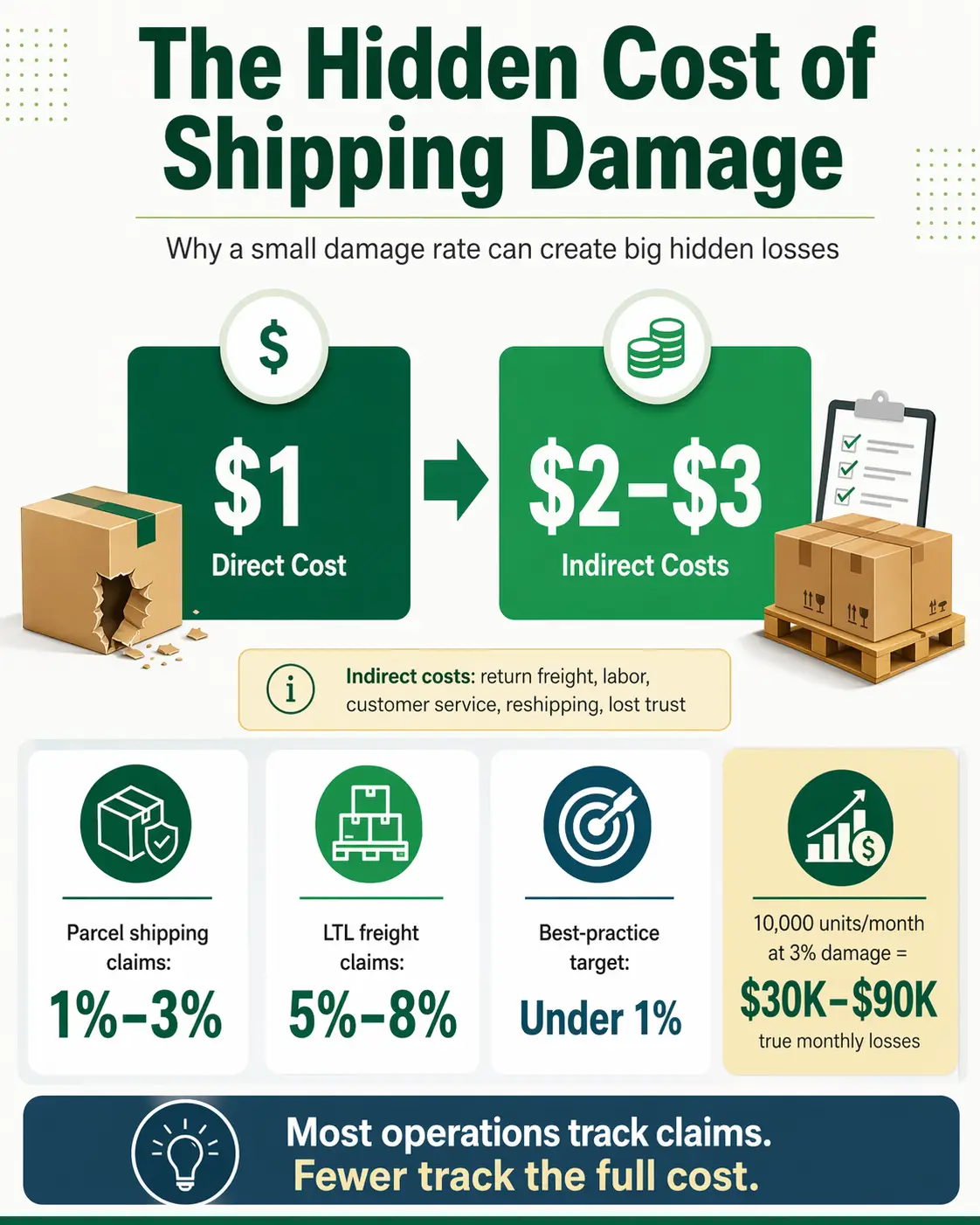
Most managers track damage claims. Fewer track the full cost of damage. There’s a meaningful difference. The visible line items are the credit memo, the replacement shipment, and the carrier claim, and are only a fraction of what damage actually costs your operation.
Industry data consistently shows that for every dollar of direct product replacement cost, organizations absorb two to three dollars in indirect costs: return freight, labor to reprocess or repack, customer service time, expedited reshipping, and the erosion of customer trust.
The Freedonia Group has estimated that damage-related packaging costs U.S. businesses over $15 billion annually when you account for the full loss chain.
For context, damage claims in parcel shipping typically run between 1% and 3% of total shipments, but in LTL freight environments, rates of 5% to 8% are not uncommon, particularly for fragile or high-density mixed loads. If you’re shipping 10,000 units a month and seeing a 3% damage rate, you’re likely absorbing $30,000 to $90,000 in true monthly losses once indirect costs are factored in.
The benchmark to aim for when you want to reduce shipping damage to a manageable level is sub-one percent. And knowing how to reduce shipping damage systematically is the only reliable path to getting there. Sub-one is achievable, but only with a systematic approach to packaging design, material selection, and process discipline.
The sections that follow give you that system.
Explore our full range of packaging products designed to protect your shipments at every stage of the supply chain.
Ready to find out where your packaging is losing you money?
Schedule a free packaging assessment with a Morrisette packaging engineer today.
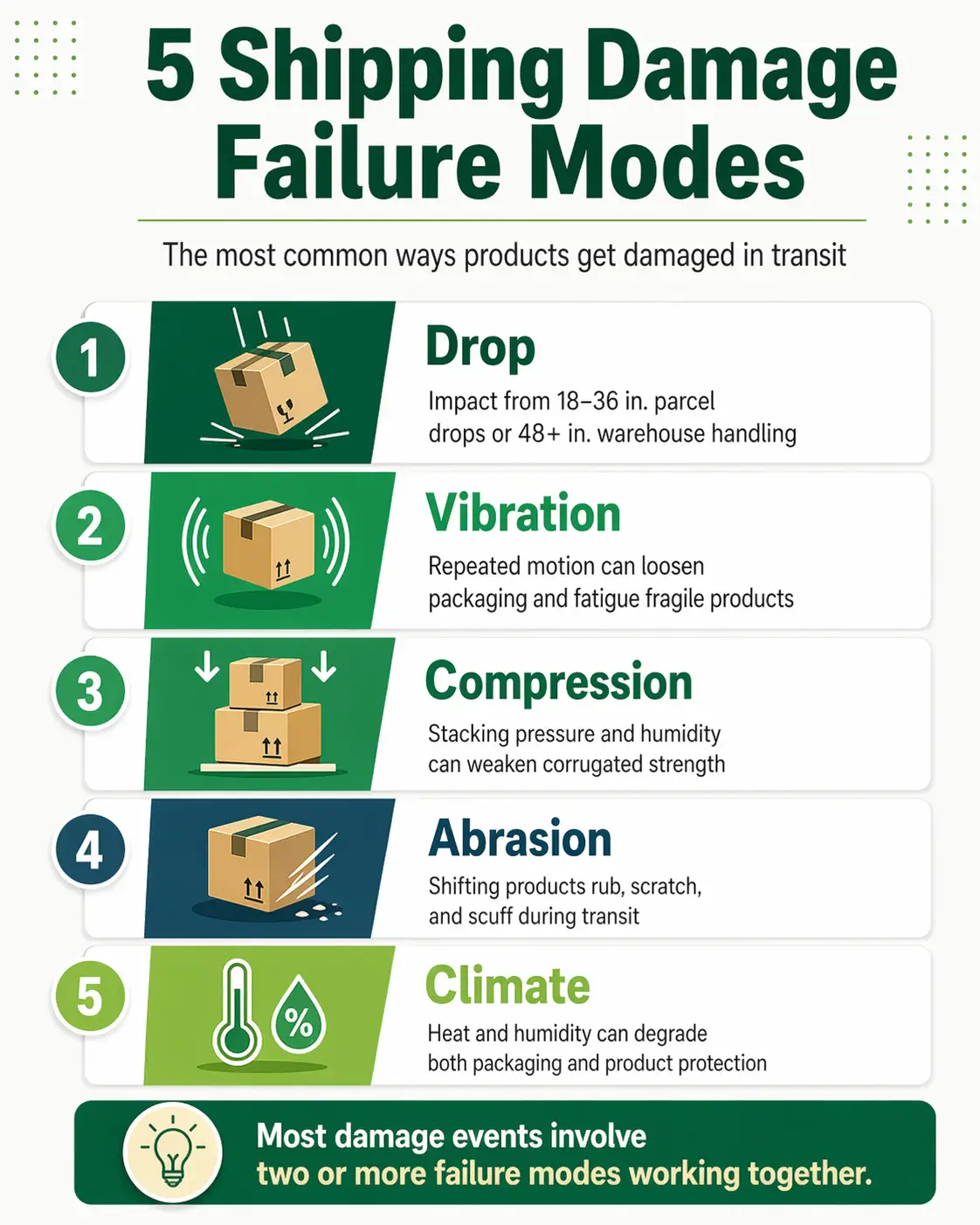
2. The 5 Most Common Causes of Shipping Damage You Need to Fix
Before you can fix a damage problem, you need to understand the physics behind it. Packaging engineers classify transit damage into five primary failure modes. Most real-world damage events involve two or more of these acting together, which is why single-solution fixes rarely work. That’s why our method and approach are so valuable. We can help design the structure, select the appropriate substrate, and walk you through the prototyping phase to ensure the final product is exactly what you need.
Drop. The most intuitive failure mode is when a box falls. What’s less intuitive is where it falls from. Parcel handlers typically drop packages from heights of 18 to 36 inches, while warehouse workers unloading pallets may drop individual cases from 48 inches or more. ISTA test standards simulate drops on faces, edges, and corners because corner drops generate the most destructive energy concentration. Your inner packaging must absorb the kinetic energy of the worst-case drop, not the average one. We design packaging specifically to protect from these types of drops.
Vibration. Sustained vibration during truck, rail, or air transit causes cumulative fatigue damage that can shatter fragile products without a single identifiable impact event. Vibration resonance is particularly dangerous because at certain frequencies, products can oscillate against their packaging and effectively “work loose” from even well-fitted foam.
Compression. In stacked storage and transit, the bottom box in a pallet column bears the weight of everything above it. An improperly designed corrugated box can lose 50% or more of its stacking strength when exposed to high humidity – a critical variable for shipments moving through the Southeast or Gulf Coast in summer months.
Abrasion. Products that shift inside packaging and rub against corrugated walls or other products develop surface damage that may not be structural but absolutely affects customer perception and return rates. This is especially critical for consumer electronics, coated surfaces, and anything with a premium unboxing expectation.
Climate. Temperature and humidity extremes don’t just affect the product; they degrade the packaging itself. Corrugated board loses stacking strength rapidly as relative humidity climbs above 70%. For temperature-sensitive products, the transit environment between Phoenix in July and a non-climate-controlled trailer is a legitimate threat vector.
Understanding which of these five failure modes is driving your damage pattern is the first step toward selecting the right mitigation strategy. See how we serve different industries facing these exact challenges at our industries page.
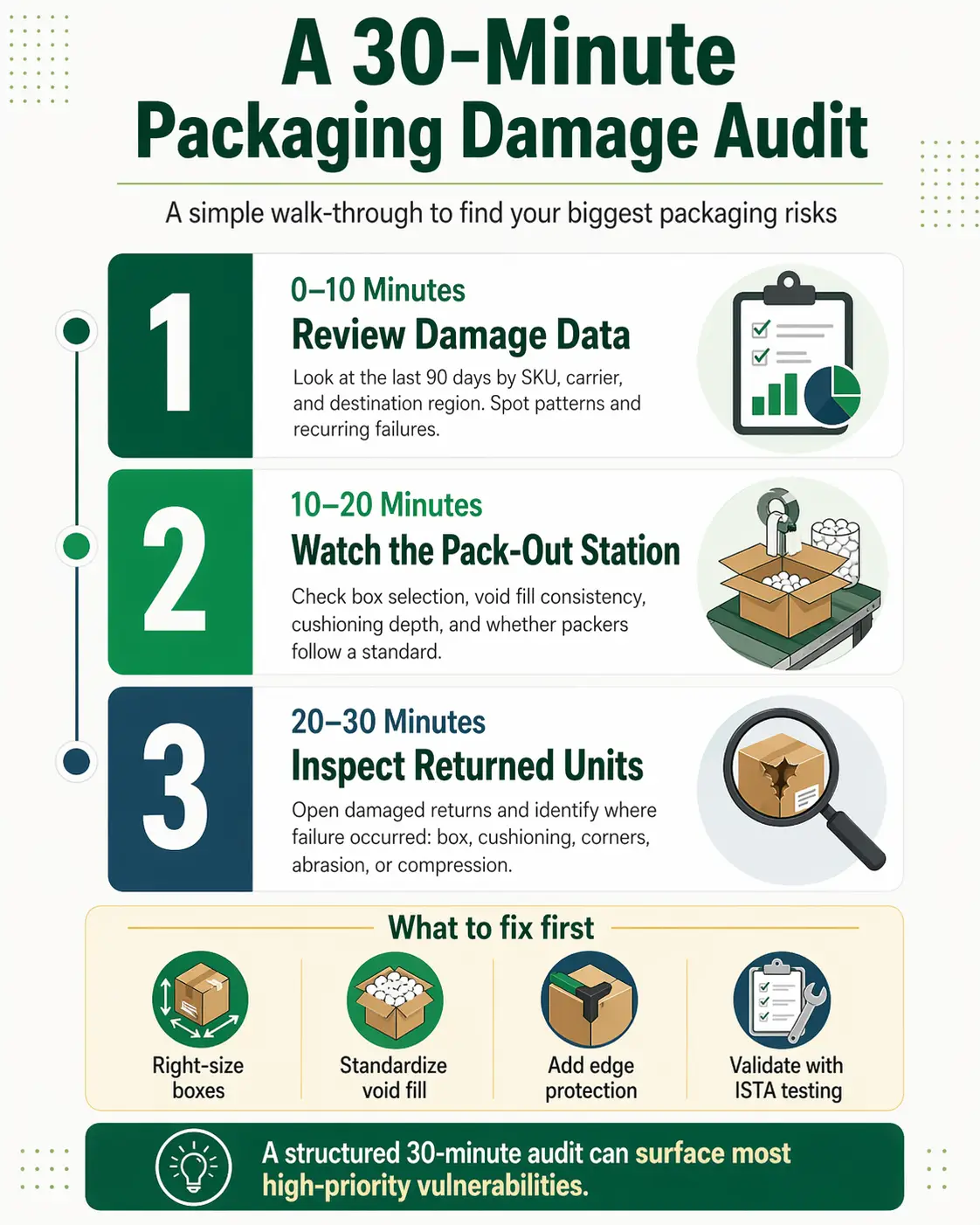
3. How to Reduce Shipping Damage Starting Today: A 30-Minute Audit
You don’t need a packaging lab to start diagnosing your damage problem. A structured 30-minute walkthrough of your operation will surface most high-priority vulnerabilities.
We would love to bring you a coffee and walk you through it.
Here’s a quick glimpse at what we will do:
Minutes 0–10: Review your damage data. Pull your last 90 days of damage claims and sort them by SKU, carrier, and destination region.
Look for patterns.
Are certain products failing more than others? Is damage concentrated with one carrier or on long-haul lanes? Are there seasonal spikes? This clustering indicates whether you have a product-specific packaging problem, a process problem, or a carrier-handling problem. Each requires a different fix.
Minutes 10–20: Walk the pack-out station. Watch how the product is packed at your pick-and-pack or shipping station.
Are packers using consistent void fill amounts, or is fill depth variable depending on who’s working the station?
Are boxes being selected based on product dimensions, or are packers grabbing whatever’s handy?
Is there any written or visual standard for packing depth and cushioning placement?
Inconsistency at the pack-out station is one of the most common and most correctable causes of elevated damage rates.
Minutes 20–30: Inspect returned and damaged units.
Open damaged returns and look at where the failure occurred.
Did the outer box fail first, or did the product break through the inner packaging?
Is the failure at corners and edges (drop damage) or uniformly distributed (compression)?
Is the product scratched but unbroken (abrasion)?
Physical forensics on returned units often tells you more in 10 minutes than a month of claim reports. Document what you find with photos and note it against the failure mode taxonomy above.
This audit gives you a prioritized list of vulnerabilities. From there, the packaging matrix in the next section helps you match the right solution to the right problem. Our resources library also has tools and guides to help you go deeper on any of these areas.
Don’t guess at your packaging gaps — let an expert confirm them.
Schedule a free packaging assessment and get actionable recommendations from a Morrisette packaging engineer.
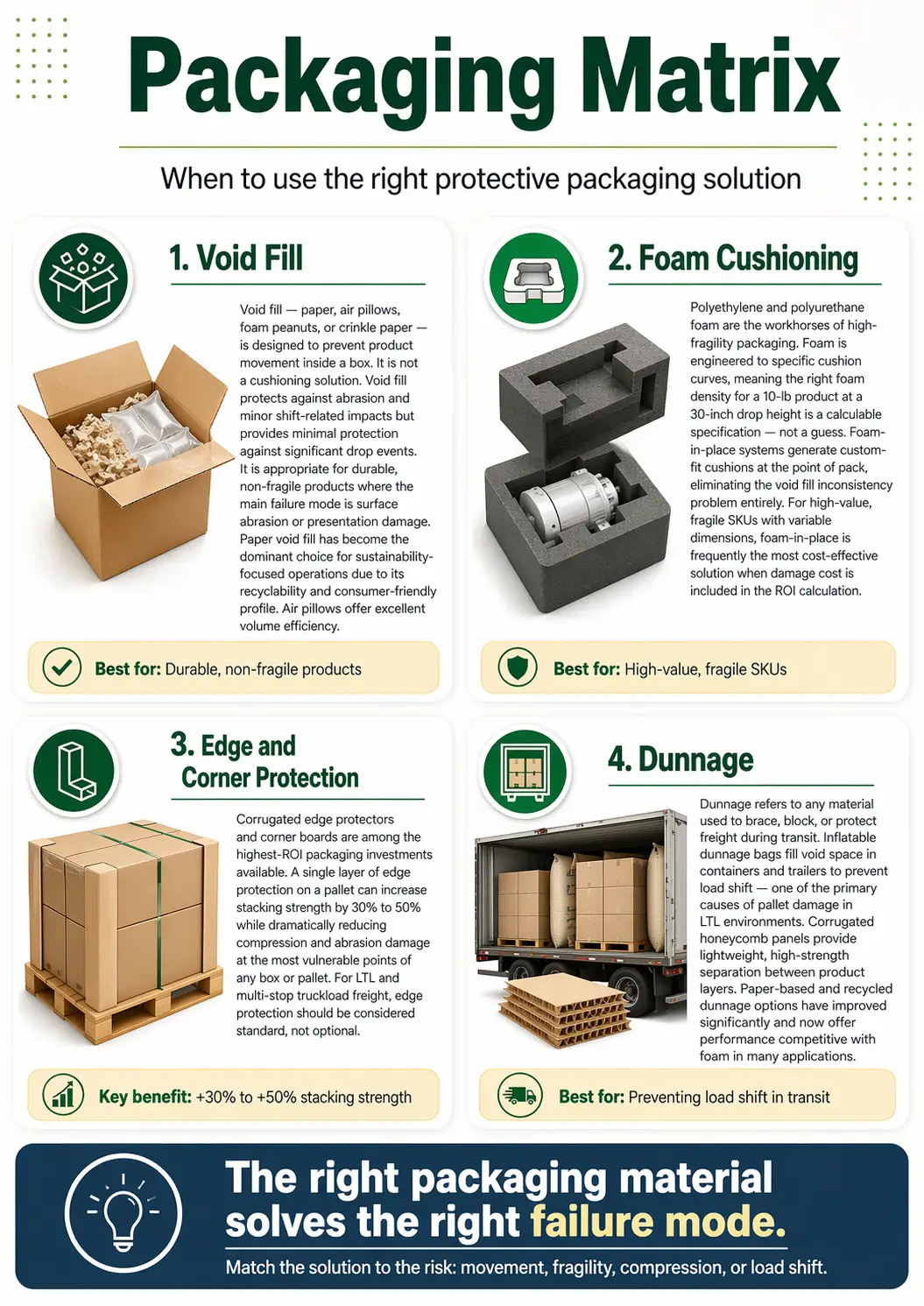
4. Protective Packaging Matrix: Void Fill, Foam, Edge Protection, Dunnage
Once you’ve identified your primary failure modes, the next step in your mission to reduce shipping damage is selecting the right protective materials.
There is no universal best solution.
The right answer depends on product fragility, transit mode, weight, cost-per-shipment targets, and sustainability commitments. Here’s how the main material categories perform across those variables.
Void Fill. Void fill — paper, air pillows, foam peanuts, or crinkle paper — is designed to prevent product movement inside a box. It is not a cushioning solution. Void fill protects against abrasion and minor shift-related impacts but provides minimal protection against significant drop events. It’s appropriate for durable, non-fragile products where your main failure mode is surface abrasion or presentation damage. Paper void fill has become the dominant choice for sustainability-focused operations due to its recyclability and consumer-friendly profile. Air pillows offer excellent volume efficiency.
Foam Cushioning. Polyethylene and polyurethane foam are the workhorses of high-fragility packaging. Foam is engineered to specific cushion curves, meaning the right foam density for a 10-lb product at a 30-inch drop height is a calculable specification — not a guess. Foam-in-place systems generate custom-fit cushions at the point of pack, eliminating void-fill inconsistency entirely. For high-value, fragile SKUs with variable dimensions, foam-in-place is often the most cost-effective solution when damage costs are included in the ROI calculation.
Edge and Corner Protection. Corrugated edge protectors and corner boards are among the highest-ROI packaging investments available. A single layer of edge protection on a pallet can increase stacking strength by 30% to 50% while dramatically reducing compression and abrasion damage at the most vulnerable points of any box or pallet. For LTL and multi-stop truckload freight, edge protection should be considered standard, not optional.
Dunnage. Dunnage refers to any material used to brace, block, or protect freight during transit. Inflatable dunnage bags fill void space in containers and trailers to prevent load shift, a primary cause of pallet damage in LTL environments.
Corrugated honeycomb panels provide lightweight, high-strength separation between product layers. Paper-based and recycled dunnage options have improved significantly and now offer performance competitive with foam in many applications.
The right protective packaging mix is almost always a combination of these solutions, and selecting it correctly is how to reduce shipping damage in a lasting, systematic way. Our packaging design team can model the optimal configuration for your specific product, weight, and transit profile. Explore our packaging products to see the full range of materials we offer.

5. When to Invest in ISTA Testing
If your operation is serious about reducing shipping damage at scale — particularly through e-commerce channels or to major retail customers — ISTA (International Safe Transit Association) testing is the most credible tool to validate that your packaging will actually protect your product in real-world conditions.
ISTA test protocols simulate the actual physical stresses of a shipping cycle: drops from standardized heights, vibration tables that replicate truck road profiles, compression loads, and in some protocols, climate conditioning. And we can help with our in-house ISTA testing protocols.
The most widely referenced protocols for parcel shippers are ISTA 2A (for packaged products under 150 lbs. in parcel delivery) and ISTA 6-Amazon (for fulfillment-center-ready packaging).
Retailers, including Amazon, Walmart, and Target, increasingly require ISTA certification as a condition of acceptance.
The business case for ISTA testing becomes clearest when you do the math on your damage rate. If you’re shipping 50,000 units per year with a 3% damage rate and an average replacement cost of $40 per unit, you’re absorbing $60,000 in direct damage costs annually. An ISTA test protocol typically costs $2,000 to $8,000, depending on complexity. If optimized packaging cuts your damage rate to 1%, you recover the test cost in weeks and save $40,000 annually going forward.
ISTA testing is also essential whenever you make significant changes to your packaging design, switch corrugated suppliers, change product weight or dimensions, or onboard new transit partners. Changes that seem minor — a different corrugated flute, a new void fill material — can meaningfully alter how a package performs under drop and vibration stress. Test data removes the guesswork.
Have questions about ISTA testing and packaging validation? Visit our FAQ page for answers to common questions.
6. Mini Case Study: John Michael Studio
Michael Sloan started John Michael Studio with his dad John in 2016 – designing and manufacturing premium outdoor and indoor living spaces.
After their first big order came through, they quickly realized that packaging and logistics would be paramount to their success. Through a collaboration with Morrisette Packaging, JMS reduced damages during transit, increased brand visibility and improved the customer experience exponentially.
The Benefits of packaging that’s tailored specifically for your application:
- Damage Prevention in Global Transit Morrisette Packaging developed specialized packaging solutions that significantly reduced damage during international shipping, ensuring John Michael Studio’s cabinetry always arrives in pristine condition.
- Tailored Packaging Design Our team crafted a custom packaging design that provides superior protection for John Michael Studio’s in-house produced cabinetry, safeguarding each piece against potential transit hazards.
- Logistics & Packaging: A Crucial Partnership Proper packaging and logistics are non-negotiable for a company like John Michael Studio, where clients pay a premium for bespoke craftsmanship. Our partnership ensures that their products meet and exceed customer expectations upon arrival.
- Enhanced Brand Reputation By ensuring that every piece of cabinetry is delivered without damage, Morrisette Packaging helps John Michael Studio maintain its reputation for excellence, leading to increased customer satisfaction and loyalty.
- Cost Efficiency: Reducing transit damage protects the product and minimizes costly returns and replacements, contributing to overall cost savings for John Michael Studio.
The lesson on how to reduce shipping damage at this scale isn’t that the solution was expensive or technically complex because it wasn’t. The lesson is that damage reduction is achievable with disciplined diagnosis, the right materials, and consistent process execution. Most operations have similar gains waiting.
If you’re ready to find out what’s possible in your facility, the starting point is the same as it was for JMK.
An honest look at the data and a structured audit of your current packaging process is the right place to start figuring out how to reduce shipping damage.
Our team works with operations of all sizes across the Southeast and beyond. Visit our industries page to see the sectors we specialize in, or explore our full suite of protective packaging products.
Your next 90 days could look like this case study.
Schedule a free packaging assessment with Morrisette’s packaging engineers and leave with a clear action plan.