Your box is a salesperson.
It stands on a shelf, on a pallet in a big-box store, or lands on someone’s doorstep, and it does its job whether anyone is watching or not. If it looks sharp, your brand looks sharp. If the colors are muddy, the registration is off, or the print quality looks like it belongs on a generic wholesale carton, that impression sticks too.
For a long time, getting high-graphics corrugated right meant stitching together two separate operations: a print vendor and a die-cutter, with a handoff between them, a coordination timeline, and a lead time that made planning feel like guesswork.
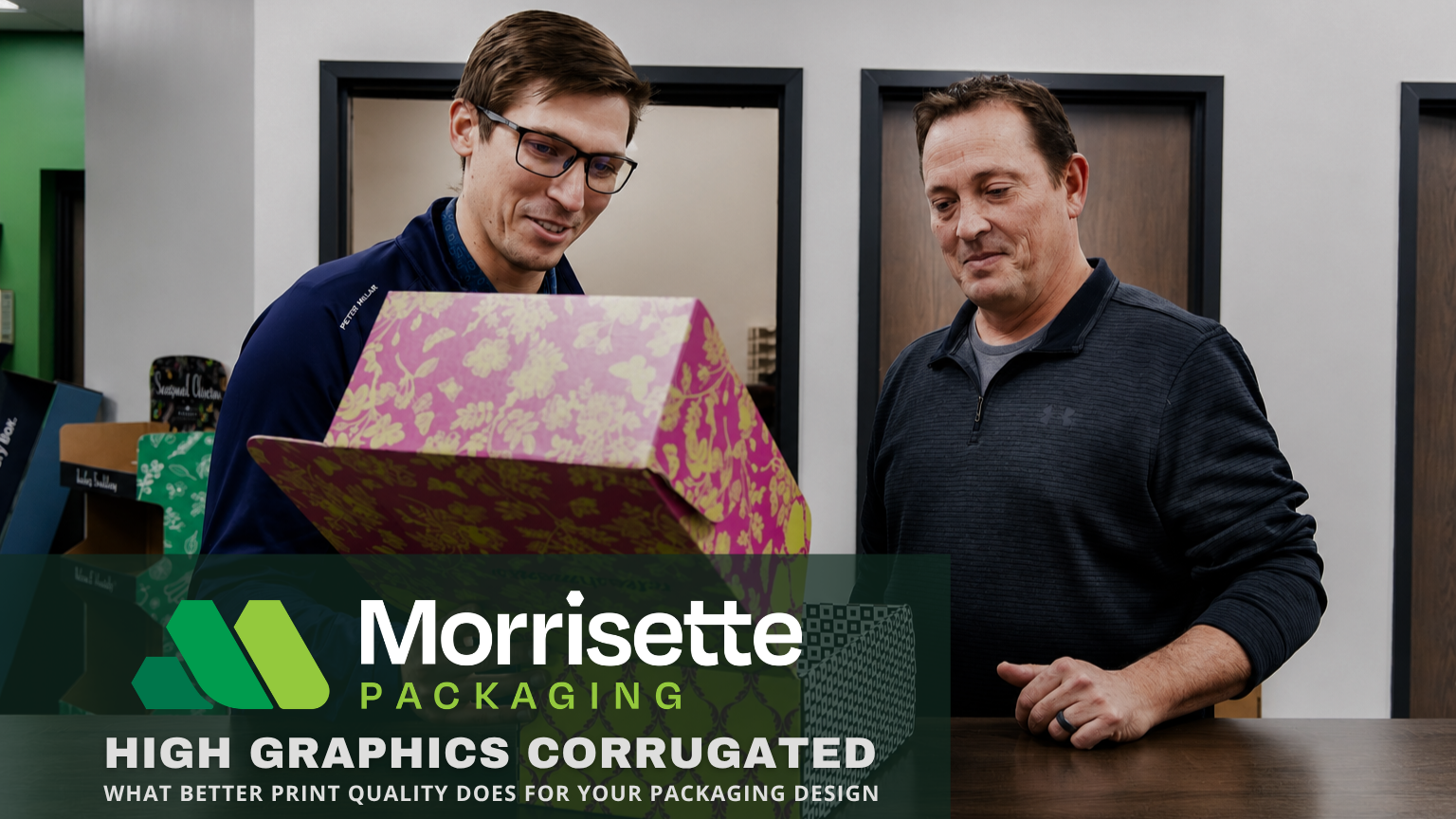
With major investments in state-of-the-art inline print-and-cut capabilities, Morrisette Packaging is now positioned to deliver high-graphics corrugated printing and precise die-cutting under the same roof where the solution was designed. True vertical integration of your packaging design and delivery process.
Print and Die-Cut in a Single Pass
The core of Morrisette’s new high-graphics corrugated capability is an inline rotary die-cutting system that combines multi-color flexographic printing and precision die-cutting in one continuous operation. The sheet goes in. A finished, printed, die-cut corrugated piece comes out. No second operation. No staging area between print and cut. No opportunity for registration to drift between the two.
Direct-drive vacuum transport holds the sheet stable through the entire pass. That is the mechanical detail that makes clean registration possible at production speeds, and it matters more than it might sound. When you are printing a logo with tight tolerances or running a color palette that depends on consistent laydown, sheet stability is not a nice-to-have. It is the difference between a box that looks right and one that needs an explanation.
For brands with complex graphic requirements, this is a meaningful upgrade in what is achievable in corrugated. Fine type, detailed artwork, tight color matching: the constraints that used to exist because of how the process worked are not the same constraints anymore.
What Changes When Everything Stays In-House
Think about what typically happens when a brand needs high-graphics corrugated. A print file goes to one vendor. A structural spec goes to a converter. Somewhere in between, there is a scheduling dependency that neither side fully controls. If the print run runs long, the cut schedule slides. If there is a registration issue, the two vendors spend time deciding whose problem it is.
That coordination cost is real, and it lands on you.
When Morrisette handles printing and die-cutting in the same facility, the coordination loop closes. Your file does not travel between vendors. Your timeline does not depend on two separate production schedules lining up. Questions about design, print spec, and structural requirements get answered in a single conversation with a single team.
For brands running seasonal packaging, retail-ready display programs, or product launches with fixed in-store dates, this timeline compression is not just convenient. It is often the difference between meeting a retail window and missing it.
Our manufacturing solutions are built around the idea that fewer handoffs mean fewer problems. This is what that looks like in corrugated.
Built for Volume. Built for Flexibility.
High-graphics corrugated is not always a simple story. Many of the brands that need this capability are running multiple SKUs, not a single box style in one run. Switching between jobs used to mean downtime that ate into the efficiency of having good equipment in the first place.
The inline system includes QuickSet automatic plate and anilox changes, which reduces job changeover time significantly. For a brand running seasonal display packaging across several product lines, or CPG packaging managing multiple SKUs through a single production window, that flexibility is what makes the solution actually work in practice rather than just in theory.
Inline defect detection and registration control runs throughout every job. Quality is not something checked at the end of a run. It is monitored continuously, which means a problem found at piece 500 does not become a problem discovered at piece 50,000. For large, recurring volume runs, that matters financially in ways that are not hard to calculate.
Food and beverage brands, pet food companies, consumer packaged goods producers, furniture and appliance manufacturers who need printed corrugated for retail environments: these are the categories where consistent throughput on high-graphic jobs is a baseline requirement, not a premium feature.
We design and manufacture packaging specifically for those requirements.
What Better Print Quality Does for Your Packaging Design
There is a ceiling on corrugated packaging design that most brands have worked around for years without thinking much about it. When you are not sure whether fine detail will hold, or whether a particular color will be consistent across a large run, you design to the constraint. You use simpler graphics. You leave more margin. You avoid type below a certain point size.
When print precision improves, that ceiling rises. Sharp registration means a smaller type can be legible. Consistent color means a complex palette can be used without hedging.
Details that previously felt risky become achievable.
Our custom design team works at the intersection of structural design and print capability, and having inline printing in-house tightens that loop in a useful way.
A conversation about whether a design can be executed well does not require a call to an outside printer to find out. The people making the box and the people designing the box are in the same building.
If you are working on a packaging refresh, preparing for a new product launch, or trying to elevate a corrugated program that has not changed much in a few years, this is a good moment to revisit what is possible. The capabilities that constrained your options before may not be the same constraints today.
It is also worth noting that better print quality does not require trading away anything on the sustainability side. Corrugated remains one of the most recyclable packaging formats available. High-graphics print on corrugated is not a compromise between shelf presence and environmental responsibility.
This Is What “From Design to Delivery” Actually Means
Morrisette Packaging has been at this since 1962. Family-owned, third-generation, with locations across North Carolina, South Carolina, and Virginia.
We have built a lot over that time: automation solutions, kitting and fulfillment services, packaging products across a wide range of categories, and a design capability that helps customers think through the full packaging picture.
Our investment in high-graphics corrugated manufacturing fits the same model. It is not a separate business unit or a pivot. It is the next piece of a capability set that has always been built around handling more of the packaging equation for the brands that work with us.
“From Design to Delivery®” describes how we operate. The corrugated box that ships your product is connected to the design decisions that shaped it, the print process that branded it, and the operational infrastructure that helped get it out the door. Keeping more of that process in-house, at a higher quality level, is what the investment in inline printing and die-cutting is about.
If you have been sourcing high-graphics corrugated from outside vendors, or if you have been settling for lower print quality because a better option was not available locally, we would like to have that conversation.
We would love to learn more about you, your goals and what we can do to help make every day better. Click here to schedule a time for a free coffee and consultation at your location with one of our Packaging Specialists.
Frequently Asked Questions About High-Graphics Corrugated Packaging
High-graphics corrugated packaging refers to corrugated cardboard boxes and displays that feature detailed, vibrant, multi-color print graphics. Unlike standard brown corrugated shipping boxes, high-graphics corrugated uses precision flexographic printing to achieve sharp registration, consistent color, and fine-detail artwork directly on the corrugated substrate. This packaging format is widely used in retail-ready packaging, consumer goods displays, e-commerce packaging, and branded shipping boxes where visual presentation directly impacts consumer perception.
Morrisette Packaging operates an inline rotary die-cutting system that combines multi-color flexographic printing and precision die-cutting in a single continuous pass. This means printing and structural cutting happen in the same operation, eliminating the vendor handoff, coordination delays, and registration drift that occur when these processes are split between two facilities. The system also features QuickSet automatic plate and anilox changes for fast job changeovers, and continuous inline defect detection and registration control throughout every run.
High-graphics corrugated packaging is especially valuable for food and beverage brands, pet food companies, consumer packaged goods (CPG) producers, furniture and appliance manufacturers, and any brand selling through retail environments where the packaging serves as a point-of-purchase display. Companies running seasonal packaging programs, retail-ready display programs, or product launches with fixed in-store dates also benefit significantly from the faster turnaround and tighter quality control that in-house printing and die-cutting provides.
When printing and die-cutting are handled by two separate vendors, your production timeline is subject to two independent schedules, two sets of handoffs, and two potential failure points. If a print run runs long, the cut schedule slides. If a registration issue arises, vendors spend time determining responsibility before it gets resolved. By keeping both operations in-house, Morrisette eliminates these scheduling dependencies. Design, print spec, and structural questions are answered by a single team in a single conversation, compressing lead times meaningfully for time-sensitive packaging programs.
Yes. Corrugated is one of the most recyclable packaging formats available, and adding high-graphics print does not change that. High-graphics corrugated packaging offers brands a way to achieve strong shelf presence and brand differentiation without compromising on environmental responsibility. Corrugated packaging is made from renewable fiber, is widely accepted in curbside recycling programs, and has high post-consumer recycled content rates across the industry. Choosing high-graphics corrugated is not a trade-off between visual impact and sustainability.
Yes. Morrisette’s custom design team works at the intersection of structural design and print capability. Because design and production are in the same building, conversations about what is achievable in print do not require going back and forth with an outside printer. The team can assess whether a graphic approach will hold at production scale, flag potential registration or color consistency issues early, and recommend design choices that maximize print quality on the corrugated substrate. This design-to-production continuity is central to Morrisette’s “From Design to Delivery®” model.
Morrisette Packaging is a family-owned, third-generation company headquartered in the Southeast United States, with locations across North Carolina, South Carolina, and Virginia. Founded in 1962, Morrisette serves brands throughout the region and nationally with packaging products, custom design, automation solutions, kitting and fulfillment services, and now in-house high-graphics corrugated manufacturing.