
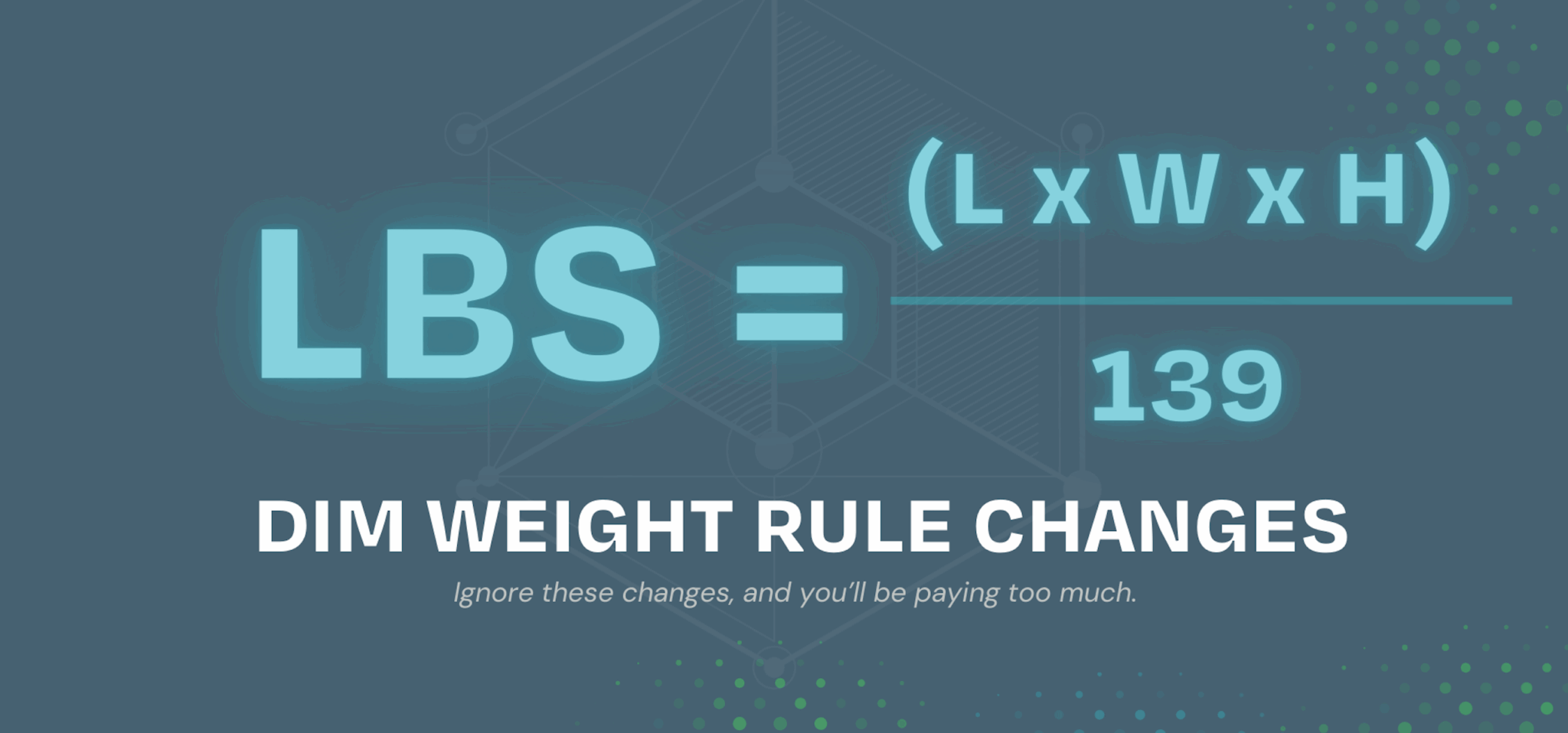
DIM Weight Just Changed. Adjust Now or Pay For Air.
TL;DR & Rule Change Timeline
TL;DR: Starting August 18, 2025, any fraction of an inch in package dimensions (L, W, H) is rounded up to the next whole inch by both FedEx and UPS before calculating dimensional (DIM) weight. That increases cubic inches → DIM weight → billable weight. Separately, FedEx now applies a 40-lb minimum billable weight when a package meets Additional Handling – Dimension (AHS–Dimension) (and in some international cases).
Timeline (U.S.):
- Jan 13, 2025: FedEx: AHS–Dimension packages subject to 40-lb minimum billable weight (domestic; also appears in international/VASS notices).
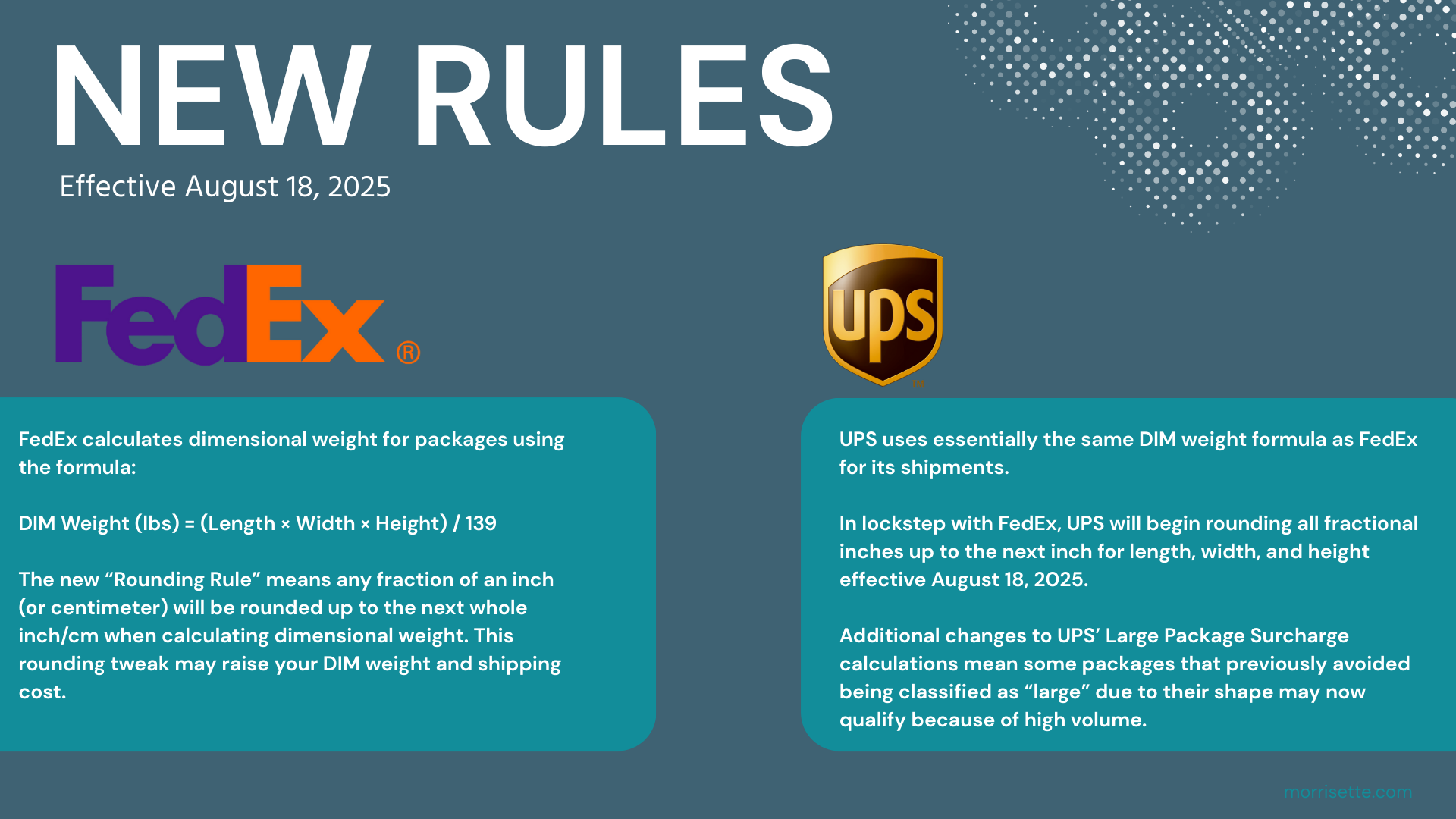
- Aug 18, 2025: FedEx & UPS: The round-up rule for every fractional inch takes effect (UPS aligns with FedEx’s change).
Why it matters: Even tiny measurements (0.1–0.9 in) now round up, inflating the volume. Example: 10.2″ × 8.7″ × 5.1″ → 11 × 9 × 6 = 594 cu in (was 10 × 9 × 5 = 450). At a 139 divisor, that’s 5 lb billable vs 4 lb previously—a 32% volume jump that can cascade into higher rates or surcharges.
“It’s Only a Tenth of an Inch”…Until It Isn’t
Starting August 18, 2025, both FedEx and UPS will round every fractional inch up when calculating dimensional (DIM) weight. That means 11.1″ becomes 12″, 8.01″ becomes 9″—for length, width, and height—before the divisor is applied. If you don’t tighten your packaging and measurement processes, your billable weight (and surcharges) can increase significantly overnight.
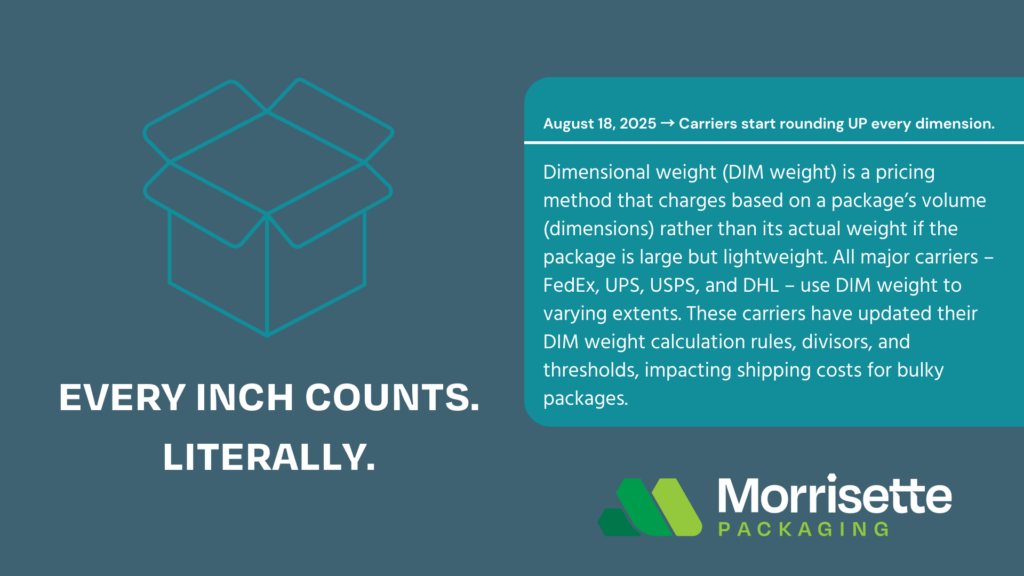
This change applies to every package dimension. UPS explicitly states that fractional measurements will now be rounded up to the next whole inch. FedEx announced the same effective date and logic in its 2025 updates. Ignore it and the cubic inches used in the DIM formula rise—sometimes dramatically.
Quick example: a box measured at 11.1″ × 8.1″ × 4.1″ becomes 12″ × 9″ × 5″ under the new rule.
Volume increases ~46% (from ~369 to 540 in³). With a divisor of 139, DIM weight rises from ~2.65 lb to ~3.88 lb—and your chargeable weight rounds up from 3 lb to 4 lb.
Don’t Miss the Fine Print That Drives Big Costs
- FedEx added a 40-lb minimum billable weight for any package that triggers Additional Handling / Dimension (and certain international cases). If you trip that threshold, your invoice won’t care what the scale says.
- UPS divisors differ by rate type: 139 for Daily Rates and 166 for Retail Rates. Know which one applies to you because the divisor directly changes the billable weight you see.
- FedEx and UPS continue to tune surcharges and demand fees throughout 2025. If you ship without a plan, you’re playing catch-up against moving goalposts.
Make Your Packaging Work Harder (So You Don’t Pay For Empty Space)

You control the dimensions, the materials, the pack-out, and the cost curve. Our role is to hand you the right playbook and run it with you.
1) Right-Size Every SKU
Goal: reduce the longest and second-longest sides that trip surcharges and inflate DIM weight.
How we help (with you): map your top movers, test smaller footprints, and pilot quick-change carton sets to minimize operational disruptions. (For some lines, we can spec on-demand or short-run custom boxes to keep inventory lean while you iterate.)
2) Engineer Protection Without Bulk
Goal: hit the same (or higher) protection performance with fewer cubic inches.
How we help (with you): swap from overstuffed void fill to precision-cut foam or engineered inserts that cradle products in a tighter box. Think “density and design,” not “air and overage.”
3) Standardize How You Measure—Then Audit Relentlessly
Goal: eliminate measurement drift and charge corrections.
How we help (with you): lock in a single SOP for L×W×H at the longest points, calibrated tools on each line, and a spot-check cadence. We’ll also build a pre-ship DIM check against your carrier divisor and the new rounding rule (Aug 18) so you see billable weight before the label prints.
Measurement SOP (longest points + round-up)
Purpose: Produce repeatable, defensible measurements that match carrier rules—reducing charge corrections and nasty surprises.
1) Tools
- A flat surface, square, tape or rigid ruler, and a camera/phone for pack-out photos.
2) Orientation
- Lay the parcel on the longest side; record L, W, H at the furthest projecting points (bulges, seams, rounded corners count).
3) Record dimensions
- Record raw decimals (e.g., 10.2, 8.7, 5.1).
- Apply the post-change rule: round each to the next whole inch (10.2→11, 8.7→9, 5.1→6). Supply Chain Dive
4) Photograph & log
- Snap top/side photos with a tape in frame; store in the SKU’s spec page. This backs you up if a carrier audits dimensions.
5) FedEx-specific note
- If your size risks AHS–Dimension, flag the SKU. Where AHS–Dimension applies, billable weight will be at least 40 lb regardless of actual weight; route to Packaging Engineering for a redesign. FedEx
6) QA cadence
Randomly audit 10% of daily shipments for 2 weeks post-implementation; compare entered vs. audited dimensions and charge corrections.
What If You Do Nothing? (The Stakes, Plain and Simple)
- Your billable weight increases even when your product weight remains unchanged. Because the inches do.
- More boxes cross surcharge thresholds (longest side, second-longest side, cubic volume), compounding cost.
- A single mis-measured tenth of an inch can push an order into an extra pound. Over a year, that’s real margin.
You deserve better than surprise invoices.
A Collaborative Plan You Can Start This Week
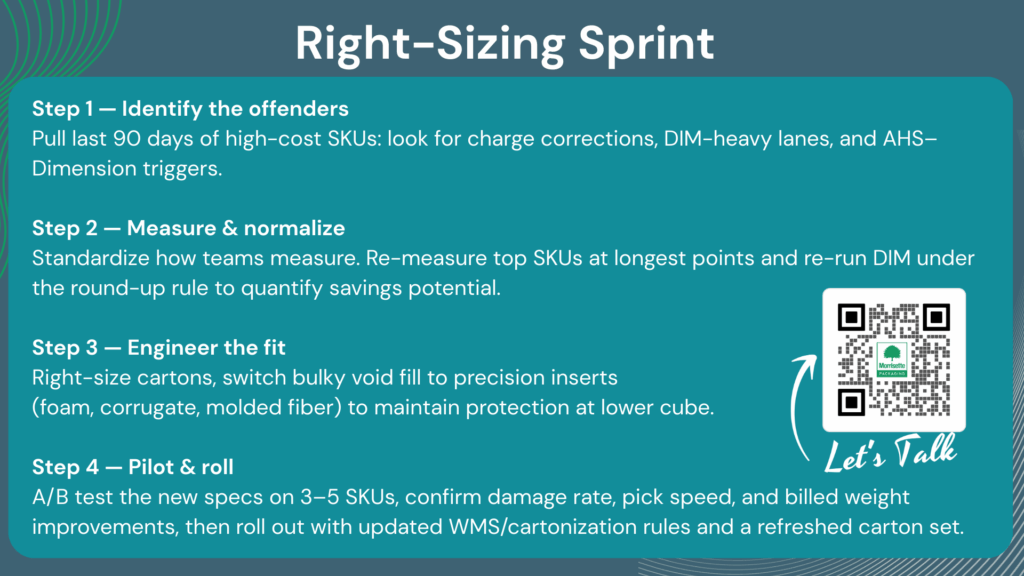
Step 1: 60-Minute DIM Impact Review
Bring your top SKUs and last 90 days of shipments. We’ll run the post-Aug 18 rounding and show where you’re paying for air.
Step 2: Rapid Right-Sizing Sprint
We co-design 2–3 tighter pack-outs (materials you already use + custom foam or inserts where it pays back fastest). You choose what works best.
Step 3: Measure, Learn, Lock
We compare pre and post analysis results, confirm that we are on the right track and help you lock down implementation.
Why This Works
Because you’re not guessing. Guesswork has consequences that are mostly negative.
For the same reason you don’t go for the cheapest option, you also don’t go with the least researched.
You’re measuring, iterating, and leading your ops with data—while we handle the heavy lifting in design, materials, and implementation. You keep control. We keep you ahead of the changes.
Contact us TODAY to get started.