
Choosing the right corrugated box starts with understanding what separates single-wall, double-wall, and triple-wall construction — and knowing which one fits your product, shipping method, and performance requirements.
This guide explains each wall type in plain terms, covers corrugated flute profiles, walks through the manufacturing process, and gives you a practical framework for making the right choice.
For more help with packaging terminology, check out our Packaging Glossary here.
What Is a Corrugated Box?
A corrugated box is a packaging structure made from containerboard — an outer linerboard, an inner linerboard, and a wavy fluted medium bonded between them. The fluted medium gives corrugated board its strength, cushioning, and resistance to crushing and puncture.
Corrugated boxes are used across virtually every industry: e-commerce, food and beverage, manufacturing, automotive, furniture, retail, and industrial distribution. They are fiber-based, widely recyclable, and available in a broad range of strengths and configurations.
The three main types of corrugated boxes are:
- Single-wall corrugated boxes
- Double-wall corrugated boxes
- Triple-wall corrugated boxes
Each type refers to the number of fluted layers inside the corrugated board. More walls generally mean more strength, but the best packaging decision depends on the product, shipping method, handling environment, and performance requirements.
The Main Types of Corrugated Boxes
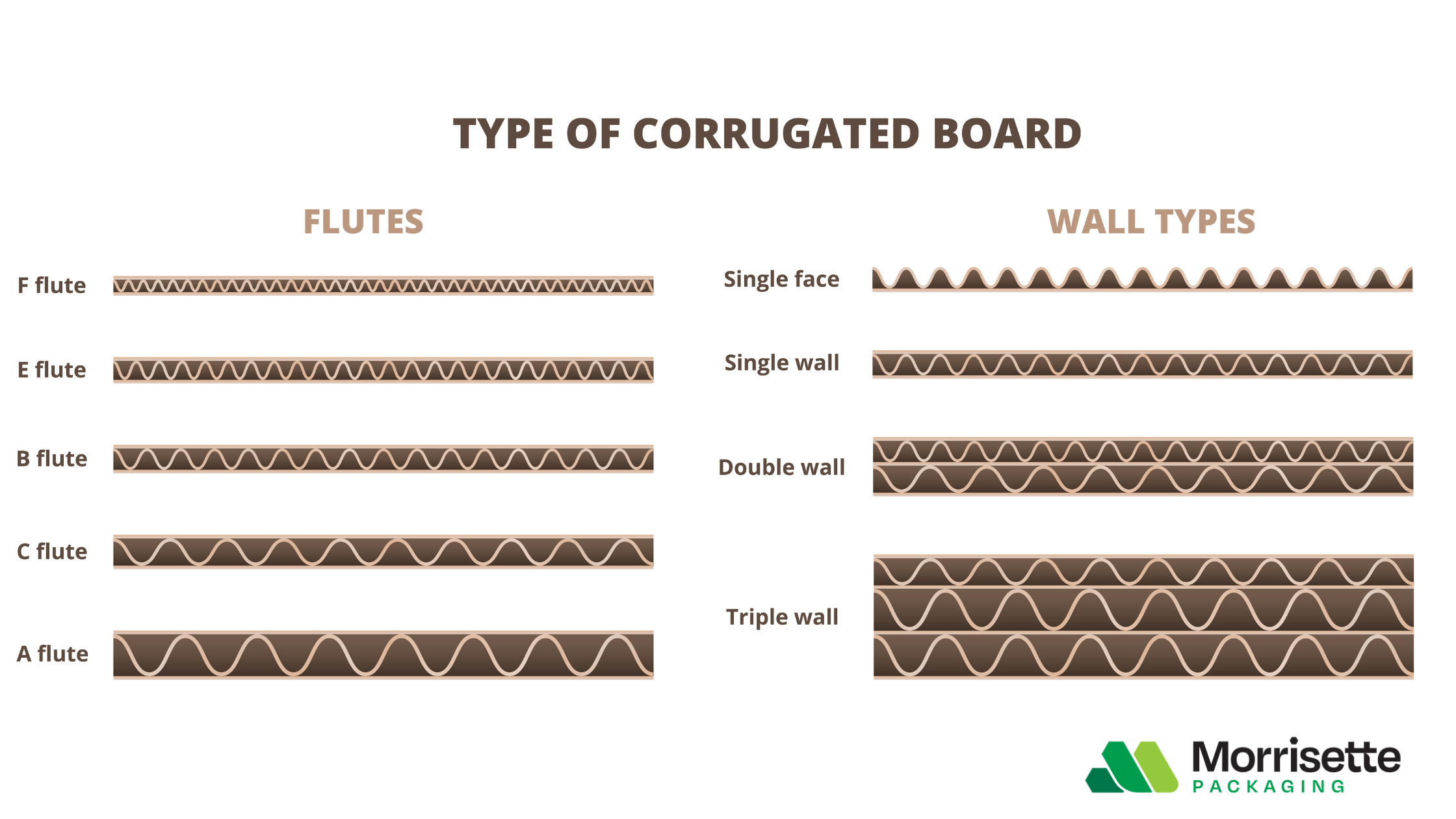
Corrugated box types are defined by their wall construction. Wall count determines strength, weight, thickness, and the range of applications each board type can reliably support.
1. Single-Wall Corrugated Boxes
Single-wall corrugated means one fluted medium is sandwiched between two linerboards. It is the most common corrugated construction and the standard choice for parcel shipping, e-commerce, retail, food packaging, and general industrial use.
Single-wall corrugated boxes are commonly used for:
- Parcel shipping
- E-commerce orders
- Retail products
- Lightweight industrial components
- Food and beverage packaging
- Subscription boxes
- Medical and pharmaceutical packaging
Benefits of single-wall corrugated boxes:
- Lowest material cost among corrugated wall types
- Lightest weight, reducing freight costs
- Strong printability, especially with smoother liners
- Widely available in standard sizes and custom configurations
- Compatible with packaging automation equipment
- Highly recyclable and available with recycled content
Limitations of single-wall corrugated boxes:
- Limited strength for heavy or fragile products
- Less compression strength under heavy stacking loads
- More vulnerable to puncture than double- or triple-wall
- May not perform well in high-humidity or refrigerated environments without special treatment
Choose single-wall corrugated when the product is light to moderately heavy, the shipping method is standard parcel or small package, and print quality or cost efficiency is a priority.
2. Double-Wall Corrugated Boxes
Double-wall corrugated means two fluted mediums and three linerboards are combined. Double-wall corrugated provides significantly more compression strength, puncture resistance, and stacking performance than single-wall board.
Double-wall corrugated boxes are commonly used for:
- Heavier manufactured goods
- Industrial components
- Furniture and home goods
- Automotive parts
- Palletized LTL freight shipments
- Products requiring more rigid structural packaging design
- High-humidity or cold-storage applications
Benefits of double-wall corrugated boxes:
- Higher compression and stacking strength than single-wall
- Greater puncture and abrasion resistance
- Better performance in LTL freight environments with multiple handling points
- Strong balance of protection and cost compared to triple-wall
- Useful for humid or refrigerated environments when paired with appropriate board grades or coatings
Limitations of double-wall corrugated boxes:
- Higher material cost than single-wall
- Greater box weight
- Less flexibility for small-format applications
- More board bulk, which can affect storage and handling
- Potentially less refined graphics performance than smoother single-wall or microflute options
Choose double-wall corrugated when the product is heavy or moderately fragile, the box will be palletized and stacked, or the shipment will move through LTL freight with multiple handling points.
3. Triple-Wall Corrugated Boxes
Triple-wall corrugated means three fluted mediums and four linerboards are combined. Triple-wall is the heaviest-duty corrugated construction, designed for extreme-weight, bulk, or industrial packaging applications where single-wall and double-wall are not sufficient.
Triple-wall corrugated boxes are commonly used for:
- Bulk bins and pallet boxes
- Heavy machinery components
- Automotive parts and assemblies
- Export packaging and overseas shipments
- Industrial goods requiring wood-crate replacement
- Products with sharp edges or concentrated loads
Benefits of triple-wall corrugated boxes:
- Highest compression and stacking strength among corrugated box types
- Better suited for large, heavy, or irregularly shaped products
- Can replace wood packaging in some applications, reducing weight and improving recyclability
- Strong bulk packaging performance for bins, pallet packs, and industrial shipments
- Fiber-based and recyclable when properly specified
Limitations of triple-wall corrugated boxes:
- Higher material cost
- Higher finished-package weight
- More storage space required
- More challenging converting and handling
- Less ideal for premium graphics or small packages
- Risk of over-engineering for products that do not require extreme protection
Choose triple-wall corrugated when the product is very heavy, bulky, sharp, or high-value, and when ordinary single-wall or double-wall construction cannot provide the required strength or protection.
Single-Wall vs. Double-Wall vs. Triple-Wall: Comparison
| Feature | Single-Wall | Double-Wall | Triple-Wall |
|---|---|---|---|
| Construction | 2 liners + 1 fluted medium | 3 liners + 2 fluted mediums | 4 liners + 3 fluted mediums |
| Strength | Moderate | High | Very high |
| Weight | Lowest | Medium | Highest |
| Material cost | Lowest | Higher | Highest |
| Printability | Strong | Good | More functional |
| Stacking strength | Moderate | Strong | Very strong |
| Puncture resistance | Moderate | Strong | Very strong |
| Best for | Standard shipping and branded boxes | Heavy-duty shipping and pallet loads | Bulk, industrial, and extreme-duty packaging |
| Sustainability | Highly recyclable | Highly recyclable | Recyclable when properly specified |
| Common users | E-commerce, retail, consumer goods | Manufacturing, food, industrial, furniture | Machinery, automotive, bulk goods, export packaging |
Corrugated Box Flute Types
Wall count is only one part of corrugated box design. The flute profile also matters. Corrugated box flute types refer to the size, spacing, and shape of the wavy medium inside corrugated board. Flutes affect cushioning, compression strength, print quality, board thickness, and overall box performance.
Common corrugated flute types are A-flute, B-flute, C-flute, E-flute, and F-flute. Each profile is suited to different packaging applications.
A-Flute
A-flute is one of the thickest common flute profiles. It provides strong cushioning and good vertical compression strength. A-flute is best for fragile products, cushioning applications, products needing extra shock absorption, and certain heavy-duty shipping boxes. The larger flute height creates more air space, which improves protection for delicate items.
B-Flute
B-flute is thinner than A-flute and offers good crush resistance with a smoother surface for printing. B-flute is best for canned goods, retail packaging, die-cut boxes, point-of-purchase displays, and products needing a balance of strength and print quality. Its denser flute pattern provides excellent puncture resistance.
C-Flute
C-flute is one of the most common flute types for shipping boxes. It offers a strong balance of cushioning, stacking strength, and general performance. C-flute is best for shipping cartons, general-purpose corrugated boxes, e-commerce packaging, consumer goods, and industrial packaging. C-flute is the most widely used flute profile in North American corrugated manufacturing.
E-Flute
E-flute is a thinner, finer flute profile that provides an excellent surface for high-quality flexographic and digital printing. E-flute is best for retail packaging, high-end consumer goods, printed packaging, lightweight displays, and shelf-ready packaging. It is sometimes called microflute.
F-Flute
F-flute is an ultra-fine microflute profile. It is even thinner than E-flute and is used where minimal board thickness is required alongside strong printability. F-flute is commonly used for small retail boxes, cosmetics packaging, and other applications where a premium printed finish and compact board profile are needed.
Common double-wall flute combinations include BC-flute (strong, durable, widely used for shipping and industrial packaging), EB-flute (combines printability with added strength), and AC-flute (thicker, with more cushioning and stacking support). The right flute combination depends on product weight, distribution hazards, printing needs, and structural design requirements.
How Corrugated Boxes Are Manufactured
Corrugated packaging begins with containerboard — the paper used to make linerboard and medium. The corrugated manufacturing process converts rolls of paper into finished boxes through a series of precise steps.
1. Paper Rolls Are Loaded
Large rolls of linerboard and medium are loaded onto the corrugator.
2. The Medium Is Fluted
The paper medium passes through heated corrugating rolls that form the wavy flute structure. The size of the rolls determines the flute profile (A, B, C, E, or F).
3. Adhesive Is Applied
A starch-based adhesive is applied to the flute tips.
4. Linerboard Is Bonded to the Fluted Medium
The fluted medium is bonded to linerboard to create single-face corrugated board.
5. Additional Liners and Mediums Are Added
For single-wall, one fluted medium is bonded between two liners. For double-wall, two fluted mediums and three liners are combined. For triple-wall, three fluted mediums and four liners are combined.
6. The Board Is Heated, Dried, and Stabilized
Heat helps set the adhesive bond and remove excess moisture.
7. The Board Is Cut and Scored
The corrugated board is slit, scored, and cut into sheets.
8. The Sheets Are Printed, Die-Cut, Folded, Glued, or Stitched
The board is converted into finished boxes, trays, POP displays, bulk bins, or custom packaging components. This is where manufacturing capability matters — corrugated packaging is not just made; it is engineered, tested, converted, and matched to the supply chain.
How to Choose the Right Type of Corrugated Box
The best corrugated box is the one that performs through the full life of the package — from manufacturing floor to customer delivery. A packaging evaluation can help identify the right structure based on real performance requirements.
Before choosing single-wall, double-wall, or triple-wall, consider these factors:
Product weight. Lightweight products often work well in single-wall boxes. Heavier products may require double-wall or triple-wall construction.
Product fragility. Fragile products may need stronger board, better cushioning, foam inserts, dividers, or a redesigned box structure.
Shipping method. Parcel shipping, LTL freight, full truckload, air freight, and export shipping all create different packaging demands.
Stacking requirements. If boxes will be stacked in a warehouse or palletized for long periods, compression strength becomes critical.
Humidity and temperature. Moisture can reduce corrugated strength significantly. Products moving through refrigerated, frozen, humid, or outdoor environments may need moisture-resistant design considerations.
Product shape. Sharp edges, concentrated loads, or irregular shapes can puncture or crush standard packaging. Protective packaging inserts or custom structural design may be needed.
Branding and print requirements. High-graphic packaging may call for specific flute types, smoother liners, or advanced printing methods such as digital printing or flexographic printing.
Sustainability goals. The goal should not simply be “less material.” The better goal is right-sized, recyclable packaging that prevents product damage and avoids unnecessary waste.
Automation compatibility. Packaging must run smoothly through erecting, filling, sealing, conveying, palletizing, and distribution systems. Packaging automation requirements should be considered early in the design process.
Total cost. The lowest-cost box is not always the lowest-cost packaging solution. Damage, freight, labor, returns, storage, and customer experience all affect total cost.
Sustainability: Are Corrugated Boxes Recyclable?
Yes. Corrugated boxes are one of the most widely recycled packaging materials in the world. Clean corrugated packaging is generally recyclable, renewable, and fiber-based. Many corrugated boxes also contain recycled content.
However, sustainability is more nuanced than simply choosing corrugated. Factors that affect recyclability and overall sustainability performance include:
- Coatings and wax treatments that can interfere with recycling
- Wet-strength treatments applied for moisture resistance
- Plastic laminations or non-paper components
- Contamination from product residue
- Over-specification — using triple-wall when single-wall would perform equally well
- Under-specification — using packaging that fails, causing product damage and reshipping waste
The most sustainable corrugated box is the one that uses the right amount of material, protects the product, minimizes damage, reduces freight inefficiency, and remains recyclable at end of life. Morrisette Packaging supports customers in specifying corrugated that meets both performance and sustainability goals.
FAQ: Single-Wall, Double-Wall, and Triple-Wall Corrugated Boxes
What is a corrugated box?
A corrugated box is a packaging structure made from linerboard and a fluted medium bonded together. The fluted medium — the wavy inner layer — provides strength, cushioning, and resistance to crushing and puncture. Corrugated boxes are used across virtually every industry for shipping, storage, retail, and industrial packaging.
What are the main types of corrugated boxes?
The main types of corrugated boxes are single-wall, double-wall, and triple-wall. Each type refers to the number of fluted mediums inside the board. Single-wall has one fluted medium, double-wall has two, and triple-wall has three.
What is a single-wall corrugated box?
A single-wall corrugated box is made with one fluted medium sandwiched between two linerboards. It is commonly used for standard shipping, e-commerce, retail packaging, and lightweight to moderately heavy products. Single-wall corrugated is the most widely used corrugated construction.
What is a double-wall corrugated box?
A double-wall corrugated box has two fluted mediums and three linerboards. It provides more strength, rigidity, puncture resistance, and stacking performance than single-wall corrugated. Double-wall is commonly used for heavier products, LTL freight, palletized loads, and industrial applications.
What is a triple-wall corrugated box?
A triple-wall corrugated box has three fluted mediums and four linerboards. It is used for heavy-duty packaging applications such as bulk bins, pallet boxes, machinery, automotive parts, and wood-crate replacement.
Is double-wall corrugated stronger than single-wall?
Yes. Double-wall corrugated is generally stronger than single-wall because it has an additional fluted medium and linerboard. This improves compression strength, puncture resistance, and durability across a wider range of shipping conditions.
Is triple-wall corrugated stronger than double-wall?
Yes. Triple-wall corrugated is generally stronger than double-wall. It is designed for the most demanding packaging applications, including very heavy products, bulk packaging, and industrial shipping environments.
What are corrugated box flute types?
Corrugated box flute types are the different profiles of the wavy medium inside corrugated board. Common flute types are A-flute (thick, strong cushioning), B-flute (good crush resistance and printability), C-flute (most common for shipping), E-flute (fine, excellent print surface), and F-flute (ultra-fine microflute for retail packaging).
Which corrugated flute type is best?
There is no single best flute type. C-flute is the most common for general shipping. B-flute offers good printability and crush resistance. E-flute is preferred for high-quality retail packaging. A-flute provides the most cushioning. The right flute depends on product weight, fragility, print requirements, and distribution method.
Are corrugated boxes recyclable?
Yes. Clean, untreated corrugated boxes are widely recyclable. Recyclability can be affected by coatings, waxes, wet-strength treatments, plastic laminations, contamination, and excessive non-paper components.
Is single-wall or double-wall better for shipping?
Single-wall is often best for standard parcel shipping and lighter products. Double-wall is better for heavier products, palletized loads, LTL freight, or applications requiring more compression strength and puncture resistance.
When should I use triple-wall corrugated?
Use triple-wall corrugated when shipping very heavy, bulky, sharp, or high-value products that require extreme strength. It is commonly used for industrial packaging, bulk bins, pallet boxes, machinery, and wood-crate replacement applications.
Can corrugated boxes replace wood crates?
In some applications, triple-wall corrugated can replace wood crates. This depends on product weight, handling method, puncture risk, compression requirements, and the shipping environment.
What type of corrugated box is most sustainable?
The most sustainable corrugated box is the one that uses the right amount of material, protects the product, minimizes damage, reduces freight inefficiency, and remains recyclable. Overbuilt packaging wastes material. Underbuilt packaging causes product damage and reshipping waste.
How do I know which corrugated box is right for my product?
The best way to choose the right corrugated box is to evaluate product weight, fragility, shipping method, stacking requirements, humidity exposure, flute type, print needs, automation requirements, and total cost. A packaging evaluation can help identify the right structure for your specific application.