If you make a medical device, a damaged shipment isn’t just an insurance claim. It’s a patient who doesn’t get what they need on time.
That’s the weight BD carries every day. As one of the largest medical technology companies in the world, BD ships products that show up in hospitals, clinics, and labs across the globe. The mission is to improve medical discovery, diagnostics, and care delivery. That mission depends, at least in part, on product arriving exactly as it left the dock.
When BD looked at their palletizing and end-of-line packaging process, they saw a gap. Inconsistent stretch wrapping creates variable load stability. Variable load stability means product damage risk that compounds across thousands of shipments. The right packaging automation solutions fixed that. That’s where Morrisette Packaging came in.
Why End-of-Line Packaging Automation Solutions Are Having Their Moment
Pallet wrap automation isn’t new. But the urgency around it is.
The global packaging machinery market is now estimated at over $82 billion, and the fastest-growing segment is end-of-line automation: stretch wrappers, case erectors, palletizers, and labeling systems that remove manual variability from the most damage-prone stage of the shipping process.
The drivers aren’t complicated. Labor availability is down. Shipping damage claims are up. The cost of a load that arrives compromised, especially in regulated industries like medical technology, is higher than ever.
The operations teams we talk to across North Carolina, South Carolina, and Virginia are reaching the same conclusion: the equipment investment pays for itself. Not because automation is the future. Because inconsistency is expensive right now.
Our packaging automation team has been having this conversation with manufacturers for years. The BD project is one of the clearest examples of what the right system, properly installed and supported, actually changes.
We would love to learn more about you, your goals and what we can do to help make every day better. Click here to schedule a time for a free coffee and consultation at your location with one of our Packaging Specialists.
What BD Needed, and Why Lantech Was the Answer
BD’s challenge wasn’t that they weren’t wrapping pallets. They were. The issue is what happens when stretch wrapping is done inconsistently: the tension varies, the number of wraps varies, the film placement varies. Across a high-volume operation, that variability adds up to a predictable damage problem.
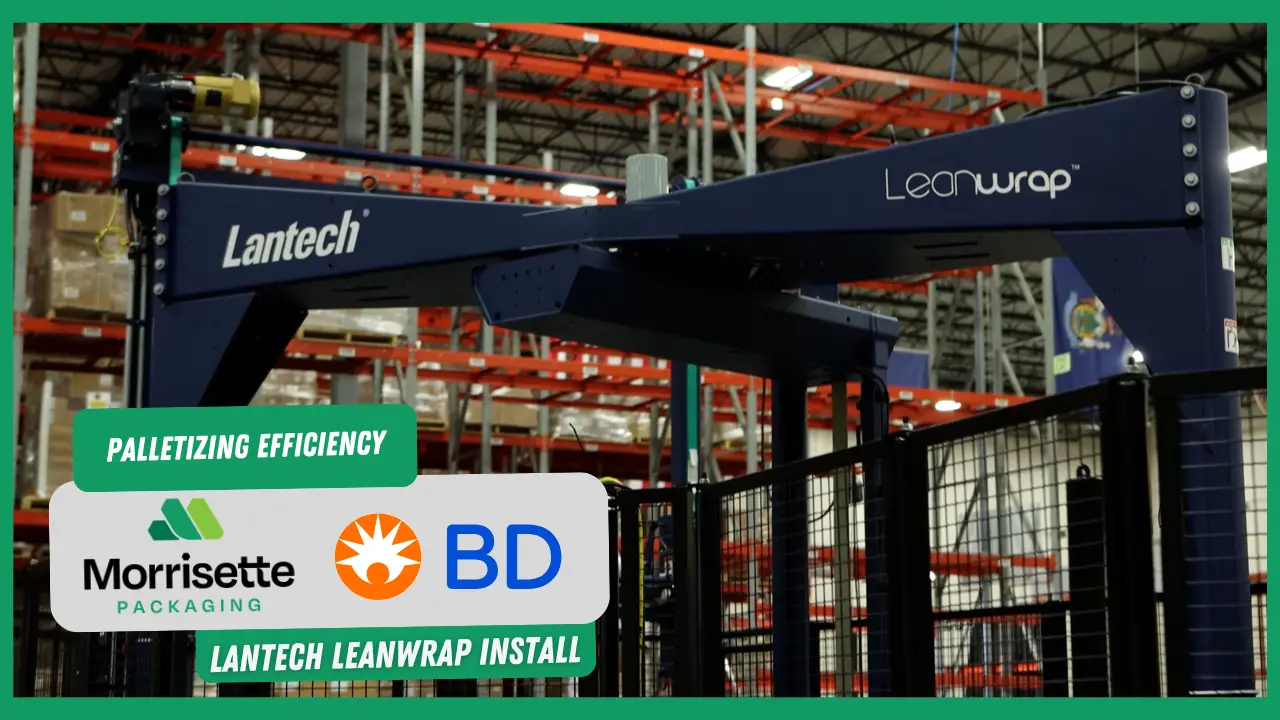
Lantech’s LeanWrap Automatic Stretch Wrapper eliminates that variability. It wraps every pallet the same way, every time, because the settings don’t change based on who’s running the machine or how tired the team is at the end of a shift.
The system is engineered around the concept of containment force, which is the inward pressure the stretch film exerts on the load. Most facilities have never measured their containment force. They rely on visual inspection: if the wrap looks tight, it passes. The LeanWrap takes that guesswork out of the process.
For BD, a company committed to improving outcomes and reducing costs across the medical technology industry, that consistency matters at every stage. Safe transit isn’t just a shipping department concern. It’s part of the product delivery promise.
How the Lantech LeanWrap Packaging Automation Solutions Work
The LeanWrap is designed to improve load stability without using more film than necessary. That second part matters more than people realize. Over-wrapping is a real problem. It wastes film, it can damage lighter loads, and it does not improve load integrity beyond a certain point. The right wrap is a calibrated wrap.
What the LeanWrap delivers is consistent pre-stretch performance, meaning the film is elongated to the correct percentage before it contacts the load. That’s how you get maximum containment force from minimum film. It’s also how you get consistent wrap profiles across every pallet that moves through the line.
Watch the full installation at BD here:
The results at BD look like what you’d expect from packaging automation solutions that remove human variability: fewer damaged loads, better film usage, and documentation that every pallet left the facility properly wrapped. That last piece carries real weight in a regulated industry. If a load arrives damaged, you want to be able to show exactly how it was wrapped.
For any operation thinking about the broader cost picture, reducing shipping damage is one of the highest-leverage improvements available. Damage claims look like a logistics problem on the P&L. They’re almost always a packaging problem at the source.
What the Installation Process Actually Looks Like
One of the first questions we hear before a project like this is: what does the transition actually look like? How long is the line down? Who handles the training? What happens when something goes wrong six months after install?
Those are the right questions, and the answers matter as much as the equipment spec.
On the BD project, Morrisette’s role started before the system was ordered. We evaluated the existing workflow, mapped where variability was entering the process, and confirmed that the LeanWrap configuration matched BD’s load profiles and throughput requirements. Getting that scoping right before equipment arrives is what separates a smooth installation from a difficult one.
The install itself was a collaborative process. Our team stayed with BD through startup, testing, and operator training. We didn’t hand over a manual and leave. Facilities across NC, SC, and Virginia have come to expect that from us, and for good reason. An automated packaging system the team doesn’t trust or doesn’t know how to run delivers a fraction of the value it’s capable of.
Post-installation, BD had access to the kind of support structure that makes automation sustainable: preventive maintenance, parts availability, and the ability to reach someone local who knows the system. We’ve been doing this since 1962, third-generation and family-owned, which means when you call with a problem you’re talking to someone who has a stake in getting it right.
We would love to learn more about you, your goals and what we can do to help make every day better. Click here to schedule a time for a free coffee and consultation at your location with one of our Packaging Specialists.
Keep Tabs on Your Packaging Automation Solutions After the Install
Installing the right system is step one. Knowing what it’s doing day-to-day is step two, and it’s the step most operations skip.
Lantech’s LINC (Lantech Intelligent Network Connection) is an IoT monitoring system built for LeanWrap Automatic Stretch Wrappers. It puts real-time machine performance data directly on your phone or desktop, before a small issue becomes a two-hour production stop.
We wrote a full breakdown of how LINC works and what it means for predictive maintenance if you want to go deeper. The short version: wrap profile changes trigger instant notifications, uptime trends are visible over time, and your maintenance team stops reacting and starts planning.
For facilities running high-volume packaging lines, that visibility isn’t a nice-to-have. It’s how you protect the investment you just made.
The Sustainability Angle Worth Knowing
Stretch wrap automation has a sustainability dimension that often gets overlooked in the ROI conversation.
Manual wrapping almost always uses more film than it needs to. The right amount of film, applied at the right pre-stretch setting, requires a calibrated machine. When you move to automated wrapping with consistent pre-stretch, you use less film per pallet. For a facility wrapping hundreds or thousands of pallets per week, that reduction adds up fast in both material cost and packaging waste.
BD’s commitment to improving healthcare efficiency extends to how they run their supply chain. Finding ways to deliver better outcomes with fewer resources is part of the same mission. A properly configured stretch wrap system is a small but real contribution to that goal.
If sustainable packaging is part of your operational priorities, and it’s increasingly part of the conversation in every sector we serve, automation is often part of how you get there. Not the entire answer. A meaningful piece of it.
What This Means for Your Operation
BD is a global company with high standards and the resources to match. But the principle this project demonstrates is not exclusive to large operations.
Any facility that ships on pallets and relies on stretch wrap for load protection is exposed to the same variability problem BD was solving. Whether you’re wrapping 50 pallets a day or 500, the question is the same: is every load leaving your dock wrapped the same way? If the answer is “probably” or “it depends on who’s working the line,” that’s worth a closer look.
Morrisette Packaging has been helping manufacturers, distributors, and healthcare companies across the Carolinas and Virginia evaluate their end-of-line packaging processes for over sixty years. We’re not here to sell you equipment you don’t need. We’re here to help you figure out where the gaps are and close them with the right packaging automation solutions — whether that’s a new stretch wrapper or a broader end-of-line automation overhaul.
Start with a conversation. We’ll bring the coffee.
We would love to learn more about you, your goals and what we can do to help make every day better. Click here to schedule a time for a free coffee and consultation at your location with one of our Packaging Specialists.